Author Archives: Jason Wendleton

Lithe-Voiced Parisian Lifts Local Boy’s Spirits

As I sit here, writing this post, I’m trapped indoors.  Outside it’s cold and snowy, the murk of winter looms large.  And yet, I’m in a sunny mood thanks to Ivy.  Over the weekend I was out grocery shopping when I heard a familiar melody cascading from the store’s P.A. system.  I removed my hat (it was covering my ears) and stood still for a moment so I could better hear the faint music.  The lyrics were familiar, but the voice was unknown to me.  Steely Dan’s “Only A Fool Would Say That” was being sung by a French woman with a beautifully delicate voice.

Regular readers of Defending Axl Rose know that I’m something of a Steely Dan nut, so I went home and did a quick search to see who did this ethereal cover. And that’s how I discovered Ivy.  A trio consisting of  Dominique Durand, Andy Chase, and Andy Schlesinger, the band’s been around since 1997.  Schlesinger is best known as the pop-mastermind behind the That Thing You Do! soundtrack and the singer-songwriter of Fountains of Wayne.  Ivy’s impressive pedigree doesn’t stop there, however, it turns out Smashing Pumpkins bassist James Iha has a habit of appearing on at least one track per Ivy album.

Ivy’s music is gentle, heartfelt, and shimmers with a breezy summer quality that has warmed this cold boy’s heart.  I highly, highly recommend their album APARTMENT LIFE and their impressive, very eclectic covers album GUESTROOM (which contains the Steely Dan track).

Ivy_band


See? I’m not all doom and gloom.

Tagged , , , , , , , , , , , , , ,

Beatles For Sale: My Rant Against The American Reissued Beatle Albums

Last month The Beatles American albums were re-issued in a large, expensive boxset. Back in 2009, when the remastered CD’s were issued, I gladly handed over my hard-earned currency for better packaging and most importantly, higher sound quality. While no doubt an opportunity to get my money again, the remastered Beatles albums gave me something I didn’t already have: better sound.  The sound quality, especially on the first few albums was vastly superior. Rather than shitty fake stereo mixes, fans were given pure mono as God, and George Martin, had intended.

"All you need is ca$h"-The Rutles

“All you need is ca$h”-The Rutles

These American re-issues are another story altogether. As far as I’m concerned, this is a disgusting money-grab with no redemptive quality for fans. The Beatles so-called American catalog exists because of corporate greed, which is the same motivating factor behind that bastardization’s re-issue. For those of you unfamiliar with what happened to the Fab Four’s albums in America, buckle-up because it’s gonna be a bumpy ride.

In 1963, after failing to break into the US, The Beatles were poised to finally conquer the Yankees. Capitol Records, the American counterpart to the band’s UK label EMI, was sitting on small pile of Beatle records. Rather than do the logical thing (i.e. issue the albums as they had been issued in England), Capitol decided to issue all new albums. Instead of releasing albums with 14 songs, as they’d done in England, The Beatles American albums were comprised of 12 songs.  And instead of simply cutting the number of songs down, the songs were swapped around in a confusing jumble.

Another major issue was The Beatles singles. In England it was considered bad form to sell people one song twice, so any song issued as a single was never included on major albums. Thus, songs like “She Loves You” and “I Want To Hold Your Hand” were never included on any British Beatles album.  Since this was not the practice in the US, Capitol Records reconfigured the American Beatle albums to include the band’s popular hit singles.

Further clouding the waters, a small independent label called Vee-Jay had the American rights to the band’s first album from 1963 to 1964. Vee-Jay got the rights to this material after Capitol Records initially passed on the Beatles in America. Thus, the band’s album PLEASE PLEASE ME was being circulated prior to Capitol’s involvement as INTRODUCING…THE BEATLES.

That’s how the American Beatles catalog got so messed up. This is how we got records like THE BEATLES IV which contains songs from BEATLES FOR SALE, HELP!, and music from the “Ticket To Ride” single. All of the Beatles records up to 1967’s SGT. PEPPER’S LONELY HEART’S CLUB BAND are a confusing mosaic of the band’s British output. The madness (mostly) ended with SGT. PEPPER due to the band’s insistence that their albums appear the same everywhere due to the artistic vision they had for that album’s concept.
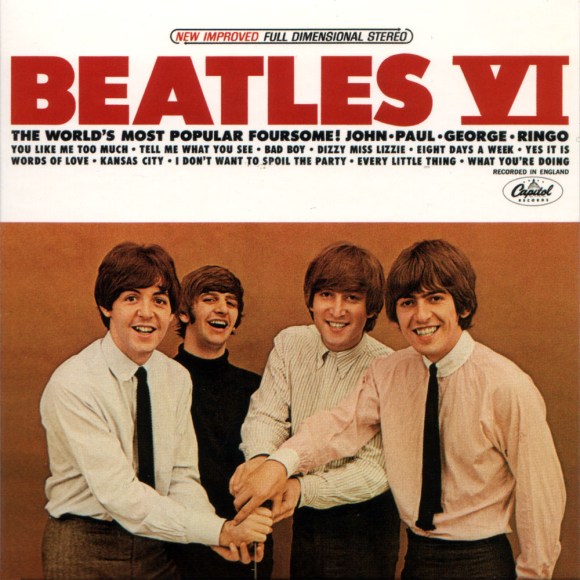
usa_beatles-vi

The American albums became something of a footnote when they were abandoned completely in the 1980’s when the band’s albums were first put onto CD. Were American fans puzzled when the British albums were released digitally? I’m sure they were, but that was decades ago. In the meantime, people like myself grew up only knowing the proper British albums. Which brings me back to the American reissued albums: who is this supposed to appeal to? Who is supposed to be forking over their money for these? Older fans who might actually remember these albums have by now long adapted to the British releases. Younger fans have never known anything but the British albums. And at this juncture in history, I think it’s safe to say that the vast majority of Beatle fans who wish to own the band’s music already do…and anyone buying the band’s records for the first time would surely buy the recognizable, iconic, British albums.

It felt strange rebuying the albums in 2009, but at least I was getting something new with the improved fidelity. But let’s be honest, the 2009 remasters were a double-dip, plain and simple.  So if the 2009 digital remasters, which I’d argue are worth the money, were a double-dip then these American reissued albums are a triple-dip. This is a product aimed squarely at the hardcore Beatle fan, the one that has to own everything with the band’s name on it.  This is a product meant to be purchased and placed on a shelf still in it’s plastic wrap.

Perhaps if I had the money, and the inclination to continue hoarding physical media, I would fall into that camp/trap. But alas, an 800 mile-cross-country move has changed the way I look at money and the owning of material goods. With this American albums reissue, The Beatles have crossed over into the horrible George Lucas/Star Wars money-grab territory.

I’m a Beatles super-fan, I’ve owned multiple copies of each of these records. Hell, I’ve owned LET IT BE in four different formats (cassette tape, vinyl LP, original CD, remastered CD).  But even as a superfan, I can see no reason to own these reissued American releases.  I don’t need different, less-iconic artwork and a swapped around track listing. In short, I don’t need these albums. I never knew them and I don’t feel it necessary to start now.

This reissue ruffles my feathers because it smacks of desperation—the last act of a band with nothing left to sell me. But that’s not true, there is one thing I’d love to buy from The Beatles. One thing that I’ve never experienced that the band continues to deny me. I speak of the lost documentary Let It Be, the legendary film the band made while writing and recording LET IT BE the album. I’ve never seen this footage, largely because it captures the breakup of the band and paints the musicians in a less-than-favorable light.

I understand that I have capitalism to thank for my Beatles albums, and that their corporate masters have every right to keep selling the same material from now until doomsday. But I wish they’d exhaust the vaults completely before they just pump out the same material over and over.

Tagged , , , , , , , , , , , , , , , , , ,

“What You Do To Me”: Potent, Perfect Power Pop!

It wasn’t until the mid-1990’s that power pop entered my life*.   Growing up listening to 60’s era British Invasion rock bands I was primed to love love power pop.  The genre with its reverence to that period of rock music struck a major nerve with me.  Essentially a cleaner, modern continuation of British Invasion rock, power pop is a big licks and killer hooks.  Its tons of fun without being sticky bubblegum, loud but lacking a hard edge, power pop is pop music on steroids.
Perfect Power Pop People!

Perfect Power Pop People!

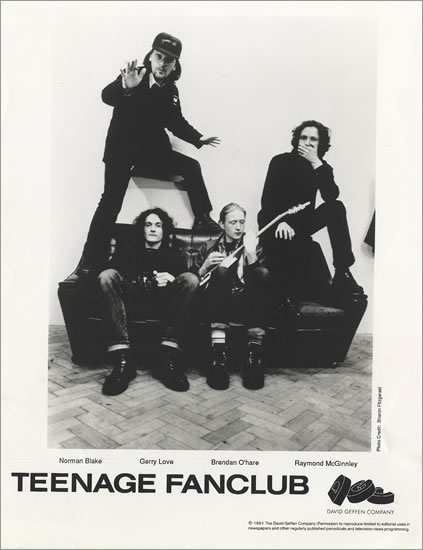
There are plenty of great power pop bands, both of yesteryear and today, but none of them can match Teenage Fanclub for purity.  Many bands skirt the edges of power pop, but Teenage Fanclub are 100% pure, uncut power pop.  Seriously, if you’ve never listened to power pop you’d be wise to start by listening to half a Teenage Fanclub song…or cut it with baby formula.  At the risk of sending potential power poppers into overdoses, I’d recommend you start with “What You Do To Me.”  The world is full of pop songs, but “What You Do To Me” is in a class all by itself.

The song dwells innocently enough on the band’s third album, BANDWAGONESQUE, which was released in 1991.  A bare bones, almost ludicrously simple love song, “What You Do To Me” is two minutes and one second of bliss.  The song has a great, crunchy guitar riff and a lyrically hook that comprises 98% of the song. It’s the kind of song you listen to and say “I could write this stuff!” because Teenage Fanclub makes it look that easy.  But it’s not that easy, or everyone would be doing it, right?  I think that effortlessness is what separates the  great from truly amazing. And Teenage Fanclub are truly amazing.

Teenage Fanclub

The song is basic its brevity manages to keeps it from being overly repetitive, achieving a miraculously high level of infectiousness while managing to avoid being tiresome.  With “What You Do To Me,” Teenage Fanclub captures the soaring wonder of love with none icky, complicated stuff like heartbreak.  Even though it’s from 1991, the song sounds like it could have been recorded yesterday.  And yet, I don’t think it would sound out of place on The Beatles first album, MEET THE BEATLES.

All of BANDWAGONESQUE is amazing, potent power pop, but the album’s crowning glory is “What You Do To Me.”  One listen, and you’ll have it in your head all day.

*Yes, I’m going to keep referencing Jellyfish until you give up and give them a listen. 
Tagged , , , , , , , , ,

“Beds Are Burning” On The Radio

There’s this “game” I like to play with my wife while we’re in the car involving the radio.  She hates it so much.  Basically, I grew up listening to so much “Classic Rock” that I can pretty much instantly identify the artist and song title of 99.999% of songs played on radio stations with a classic rock format.  My wife, a casual music lover, hates it when I switch on the radio and ask: “Do you know who this is?” Sometimes I give her little clues, sometimes I don’t.  Occasionally she’ll offer a few guesses before giving up, but most of the time she complains and says things like “I don’t like this game” or “Turn the radio off.”

I can’t help it.  My mind is a catalogue overflowing with classic rock song/artist data.  It’s actually pretty embarrassing considering all the other things I have trouble remembering (like my wedding anniversary).  The only time that this information is useful is when we play bar trivia.  And as I get old, I don’t do that nearly enough to justify all this useless knowledge.

Now that I’ve relocated to Colorado, I’ve had to cancel my paid Spotify subscription and navigate my new city’s radio stations.  After trying a few out, I landed on a pretty good classic rock station that does a good job of playing hits while also spinning deeper album cuts.  And while I’m shocked to learn that Red Hot Chili Peppers are now considered classic rock…I’ve been happy overall with my new radio station (99.5FM The Mountain in case you were wondering). There’s a DJ that does a mid-day segment called the classic rock resurrection where a song not typically played in rotation is spotlighted.  I’ve heard a few of these, and while I might not have always known the exact song title, I always knew the artist.

Such nice lads, can you believe I'd never heard of them?

Such nice lads, can you believe I’d never heard of them?

That is until last week. Last week I was totally 100% stumped by one of these resurrections—I couldn’t place the artist or the song title.  It was vaguely familiar and from the production I could tell it was definitely recorded in the 1980’s.  But I was shockingly stumped. Luckily for me, the Shazam app was able to quickly inform me that I was hearing “Beds Are Burning” by Midnight Oil.  Unlike my wife, I actually get really excited whenever I hear an old song I don’t recognize.  And I get twice as excited when I end up liking a song I’ve never heard before. So this week I’ve been listening to Midnight Oil’s 1987 album DIESEL AND DUST, which I’ve discovered is really, really good.

Moral of the story: I don’t know as much as I think I do and there’s nothing wrong with not knowing what’s always on the radio.

Tagged , , , , ,

BIG STAR: NOTHING CAN HURT ME

Big Star is one of those bands that prove that life isn’t fair.  We like to tell ourselves, especially here in the United States, that the cream always rises to the top.  The deck may not always be stacked in our favor, but with a little hard work and talent you’ll always succeed. Wrong.  Sometimes the best and brightest, the most talented people on the planet are ignored.  When this happens we search for a reason, a why that fits with our grand vision of an inherently fair universe.  English rockers XTC are a good example.  They didn’t get famous because their lead singer developed crippling stage anxiety, right?  Well that didn’t stop Brian Wilson, who stuck to the studio and still managed to find success. The truth is not everyone with big talent winds up a big star.

I happened upon Big Star the way most people do: by reading album reviews.  Once I got into indie bands, I started reading reviews in which critics compared bands to The Beatles and Big Star, always it seemed it was those two bands.  The first band I knew pretty well and so I was able to make the connection the critical shorthand was conveying.  But what the heck was Big Star?  Bands that I thought sounded a bit like Cheap Trick were often said to be “Big Star-ish.”  At a certain point, I got tired of being out of the loop and I ordered a copy of #1 ALBUM/RADIO CITY.  That this disc was actually a bastardization of two albums was something I only learned later.  By fusing the band’s first two albums together, Big Star’s current corporate owners created the single greatest dollar-per-song ratio of any album I’ve ever purchased.  For video game fans, #1 ALBUM/RADIO CITY is the musical equivalent of Valve’s Orange Box.  The damn thing is basically a Greatest Hits record.

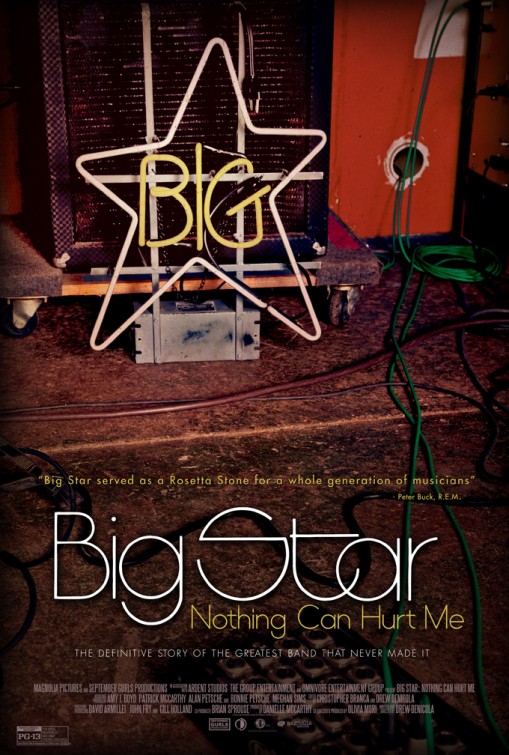
Except, there were no hits.   I didn’t understand what happened, or why, until I sat down and watched Drew DeNicola’s documentary NOTHING CAN HURT ME.  The answers aren’t as simple as the band didn’t sell albums because “X” happened.  The band formed in Memphis, Tennessee in the early 1970’s and got hooked up with the floundering STAX records.  Known more for soul/R&B music, STAX and its demise are a large part of the reason Big Star remained unknown for so very long.  But just blaming a label is an oversimplification.  The truth, which NOTHING CAN HURT ME explores, is more complex.

big_star_nothing_can_hurt_me

Lead singer Alex Chilton and singer/guitarist Chris Bell formed a fragile, Lennon-McCartney relationship that produced the confidently-titled #1 RECORD. The album failed to connect with rock fans despite a frustratingly large amount of critical acclaim.  Dejected, Bell left the band and sort of lost his mind.  This is where Big Star started to fall apart.  A second album RADIO CITY, was produced, and was met with even greater critical acclaim and even less commercial success. Part of the album’s failure certainly had to do with the aforementioned STAX going belly-up after years of mis-management.

NOTHING CAN HURT ME follows Chilton and Bell as they spend the rest of their post RADIO CITY-lives in a stunned dazed wondering how had something so good gone unrecognized?  Bell winds up working at a fast food restaurant where fans eventually find him and track him down.  Chilton, who stayed in the public eye by remaining in music, became the target of ire because he chose to step away from the power-pop of Big Star and record avante-garde punk.

The film does a good job of charting the band’s rise.  In fact, it does such a good job that when the band’s albums fail to make an impact I found myself a little surprised, even though I knew the band’s history.  I also appreciated the interviews with Bell’s sister near the end, who is both bitter about how the music industry had so deeply hurt her brother and amazed that fans now make pilgrimages to his old home.  There were very few startling revelations in the film, with one notable exception.  As someone that got on the Big Star bandwagon very late (but then again, aren’t we all?) I was shocked to learn that Big Star was really Bell’s band and not Chilton’s.  Listening to Bell’s posthumously released solo album, I AM THE COSMOS (which I hadn’t even known existed), it becomes apparent where the bulk of the Big Star magic originated.

NOTHING CAN HURT ME while worth watching, isn’t perfect.  The documentary doesn’t feature any interviews with either Bell or Chilton because, sadly, they’re both dead.  Bell died tragically at age 27 and Chilton a few years before the 2012 documentary was shot.  Their absence from the film is glaring and the unfortunate result of the band’s delayed fame.  Another glaring omission, in my opinion, is a proper explanation of  Big Star’s legend and how the band’s cult following grew over the years.  This should be the heart of the documentary but instead is glossed over.  I’d have liked for NOTHING CAN HURT ME to show me how this obscure Memphis band appreciated over time until I had no choice but to seek out their albums just so I’d know what everyone was talking about.   Alas, the documentary choses to focus on the sad trajectory of Chris Bell’s life rather than explore how Big Star got so much underground notoriety.

Overall, I enjoyed NOTHING CAN HURT ME, but I still feel like there’s a better Big Star documentary out there somewhere.  Or at least, one that’s a more definitive look at the band’s life and resurrection.  Of course, without Bell and Chilton, that’s probably not true.  I’d recommend the film, but only after you’ve listened to #1 RECORD and RADIO CITY a few times.

NOTHING CAN HURT ME is available now on Netflix’s US instant-streaming service.

Tagged , , , , , , , , ,

Rock ‘N Mailbag! #1: PRIMAL RUMBLE by Gretchen Lohse

Welcome to the first installment of a new series titled Rock ‘N Mailbag! For a few months now, I’ve been getting solicitations via email from independent artists wishing me to review their albums.  I’m not sure how these people are finding me, but rather than dismiss them, I’ve decided to listen to them and give them a little love.

This first installment of the Rock ‘N Mailbag! will be devoted to Philadelphia singer-songstress Gretchen Lohse’s latest album PRIMAL RUMBLE.  A little research shows that Gretchen was in a band called Yellow Humphrey prior to striking out as a solo artist.  Right away I was determined to review this album based solely on the David Bowie-ish album artwork.  Depicting Lohse as a medicine cabinet/astronaut, I was prepared for freaky stuff.  To my surprise, PRIMAL RUMBLE is a gentle folk and jazz tinged album full of quiet reflection.  The album is understated and tastefully produced with interesting, but not overbearing keyboards and a glockenspiel.  

GretchenInASpaceSuit

Gretchen’s voice is soft, but strong throughout PRIMAL RUMBLE and reminds me a bit of She & Him’s Zooey Deschanel.  But whereas Deschanel is at times annoyingly twee and indie, Lohse retains artistic credibility by avoiding clichés and staying interesting (read: slightly strange). Stand out tracks for me were the lopping, gentle ballad “Rings” and the flute-filled “The Cuckoo.” Both of these songs, like the rest of the album, seem both really sad while at the same time being upbeat.  The whole album feels this way, confusing but in a pleasant ethereal sort of way.

Really I only have one quibble with PRIMAL RUMBLE: for album with such a strong title, this album is way too low-key.  All the songs seem to float along at the same temp: slow.  I’m okay with albums having consistent moods, but I would have liked for a little bit more pep.  Just one or two perkier songs would have livened things up.   “The Cuckoo” and “Spider At The Gate” feature unique and interesting musical flourishes, but even these make it difficult to set these tracks apart from one another.  Remember, I’m a guy who has a Guns N’ Roses-themed blog, so take this complaint with a grain of (rock) salt.  I am interested in what Yellow Humphrey sounds like, only to see how Gretchen’s voice works in a larger band setting.

This sort of dreamy folk-pop isn’t my usual cup of tea, but I enjoyed PRIMAL RUMBLE enough to recommend it for people who like She & Him or Joni Mitchell.  PRIMAL RUMBLE is available on Spotify and you can download the album at Gretchen’s Bandcamp website for $6.00.


HAVE A HOT TIP? WANT ME TO REVIEW YOUR BAND’S SONG/ALBUM? HIT ME UP AT DEFENDINGAXLROSE@GMAIL.COM

Tagged , , , , , , , , , , , , , , ,

ROCK N’ READ: WAGING HEAVY PEACE

I just finished reading Neil Young’s 2012 autobiography Waging Heavy Peace and I’m feeling really conflicted.  The best memoirs are the ones that feel like you’re sitting with the author listening to their stories.  And while Waging Heavy Peace fails on a number of levels, one thing it does well is capturing the essence of Young.  Reading the book totally felt like having a conversation with Neil Young, albeit a really one-sided conversation.  I really wanted to recommend the book, but Young’s scattershot recollections and constant jumps through his life’s chronology make Waging Heavy Peace a tough read for anyone not already a die-hard fan.  I’m okay with a non-linear account of one’s life, but it has to be done correctly and Young isn’t up to the task. Young also tends to refer to his famous friends as…well his friends.  Paul McCartney is “my friend Paul” which is really cool and down to earth, but also very hard to suss-out when reading a book about someone’s life in which they meet a lot of famous and un-famous people.

9780142180310_custom-15a4e7fe3c7e98a8179ae2f30cc37dfcdcde8225-s6-c30

Also frustrating is the fact that a sizeable chunk of the book is devoted to Young’s passion projects: a “revolutionary” new audio system called PureTone (which is later renamed to Pono), an extensive collection of Lionel model trains, old cars that Young buys online, the Lincvolt electric car he’s building/financing to raise awareness about fossil fuels. Like a timeshare meeting where you’re given a free vacation, if you can sit through Neil’s PureTone pitches you’re free to wander about his strange life.

I don’t mind a legacy artist (as he describes himself) indulging himself and talking up his pet projects, but Young brings these things up multiple times.  Worse, he usually just regurgitates what he’s already said about them.  This gives the book a feeling as though it was patched together and not edited very well.  The looseness of the book, indeed the reason the book exists, is that Young has learned he is on the cusp of dementia. So I’ve decided to cut Young some slack in regards to the repetition in some of the book.  In the beginning, Young explains that he broke a toe and stopped smoking marijuana on the advice of his doctor.  These two events forced the legendary musician to temporarily give up music, so he sat down and wrote Waging Heavy Peace. I really did enjoy Young’s discussion of sobriety and it’s effect on his music.  He explains that he’s never written anything without being under the influence and is worried he won’t be able to access the “cosmic” world of music without drugs.  It’s a valid worry and it was interesting to read about his hopes and fears regarding his music.

As the book plods along, he writes about how long it’s been since he’s smoked or drank and correlates that to how long it’s been since he’s written a song.  Neil’s album PSYCHEDELIC PILL was my number one album of 2012 and I hope he wrote and recorded it after/during the writing of this book, but it’s not made clear.  In fact, throughout the book he talks about getting Crazy Horse back together to cut an album, but never writes about doing it…so I’m thinking the album was done after the book.  It would have been nice for him to add an extra chapter explaining how it went.  I think PSYCHEDELIC PILL is one of Young’s best albums, so if he did it sober that would be so amazing.

I admire the guts it takes to write an account of ones life, and despite being a notorious curmudgeon, Young frequently acknowledges his mistakes.  This more than honest look at himself and his career is what saves Waging Heavy Peace and refreshingly, at no point in the book does Neil Young come across as anything but authentic.

I didn’t pick the book up just to read the story about his relationship with Kurt Cobain, who famously quoted Young in his suicide letter, but at the time the book was published there were stories in the media that led me to believe this topic would be addressed in Waging Heavy Peace Sadly, Cobain is mentioned fleetingly—like just one sentence.  It was disappointing, but that’s not Young’s fault.   Young’s experiences as an illegal (undocumented) alien at the start of his career were fascinating.  I knew that Young was Canadian at a time when it was uncool to be from the Great White North, but I had no idea he snuck into the country and was terrified each and every time he got behind the wheel of a car.  He had no license or Social Security card for many years and to this day still has pangs of fear when he sees a Sheriff’s patrol car.

Waging Heavy Peace reminded me a lot of Bob Dylan’s 2004 autobiography Chronicles Volume 1.  Like Dylan’s book, Waging Heavy Peace is an unconventional and unfinished look at a legendary life.  On the final page Young says that there will be future books, which may someday surface and shed more light Young’s remarkable career.  I’m not sure if I’d pick up Young’s next book, at least, not for $30.00. If you’re a fan and still haven’t picked the book up I definitely recommend you do.  For everyone else, I’d say familiarize yourself with Young’s music and maybe pick up another biography before wading into Waging Heavy Peace.

Tagged , , , , , , , , , , , , , , , , , ,

DEFENDING AXL ROSE: Part 2 “Shackler’s Revenge”

Welcome to part two of a fourteen part series in which I go track-by-track through CHINESE DEMOCRACY. It’s been over two years since I did the first installment on the first song…but I’m back defending Axl Rose!

I’d heard several songs off CHINESE DEMOCRACY prior to the album’s official November 2008 release, but “Shackler’s Revenge” was the first officially-Axl-sanctioned track I heard. The song was previewed in the Harmonix rhythm game Rock Band 2, which came out a month before CHINESE DEMOCRACY was released. I remember playing the game for hours the day it came out trying to unlock the song. When I finally got a chance to play “Shackler’s Revenge” I was pretty disappointed. Unlike the rough leaked tracks I’d heard, “Shackler’s Revenge” had a gritty industrial feel. I was also taken aback by the song’s production, which was busier than most hard rock songs. This negative reaction was repeated when I bought the album a month later.

For the record: not my score, not my Xbox ID, and not screen cap.

For the record: not my score, not my Xbox ID, and not screen cap.

Five years and many listens later, I like “Shackler’s Revenge” much more than I did when I first heard it in Rock Band. That said, this track is probably the most over-stuffed/produced track on the album. Everything about “Shackler’s Revenge” is big. The song has the most credited writers of any song on the album (five in case you were wondering). The song has multiple guitar solos and multiple guitarists. And despite this largeness, the song is the second shortest track on the record, clocking in at three and a half-minutes in length.

The track is an epic, aggressive romp through burning fields of an apocalyptic hard rock landscape. The song might not have struck me as very Guns N’ Roses-like the first time I heard it, but “Shackler’s Revenge” actually has all the main ingredients of a great GNR song. The song features lead and backing vocals from Axl, where are layered on multiple tracks creating a creepy Axl-choir. “Shackler’s Revenge” is angry and defiant with an absolute killer chorus that seems to wag a finger at all of Axl’s doubters.

GNR’s songs are also known for their guitar and “Shackler’s Revenge” does not disappoint on this end. The song features interesting guitar work from the avant-garde guitarist Buckethead and the band’s other guitarist Bumblefoot. I’m not 100% sure which one of these guitarists did the solos, but they’re fantastically explosive. I also really like the dying Galaga machine-like quality of the guitar tone.

The song’s dark, apocalyptic nature recalls the band’s previous “Oh My God.” That track, which came out on the END OF DAYS soundtrack in 1999, almost seems like a proto-“Shackler’s Revenge.” Axl has publically stated that “Oh My God” was released unfinished due to time constraints relating to the release of the film End of Days. A comparison of the two tracks is a fascinating: both have an aggressive, industrial metal feel but whereas “Oh My God” seems to be an endless gushing rant, “Shackler’s Revenge” has a methodical, demonic groove. The more refined “Shackler’s Revenge” is a testament to Axl’s tireless perfectionism. I’m not a big fan of sub-genre that the song mines, but the song has grown on me over the years. That said, releasing “Shackler’s Revenge” as the album’s first single was probably a mistake. From a business perspective, it makes sense to release the shorter more dynamic track but for my money the album’s third track “Better” would have made a better single (pun intended.

But I’ll write more about that when in the next installment of my track-by-track review of CHINESE DEMOCRACY.

Tagged , , , , , , , , , , , , , , ,

Amazing Soul Rendition of Black Sabbath’s “Changes”

Soul-singer Charles Bradley made a big splash a few years ago with his album NO TIME FOR DREAMING.  You might recall that album got a lot of attention due in part to two really interesting covers. One was a version of Neil Young’s “Heart of Gold” and the other was a fantastic rendition of Nirvana’s “Stay Away.”

Well Bradley is back and so are his oddball covers! This time he chose Black Sabbath’s “Changes.”  I’d love this guy for nothing else but his song choices were it not for the fact that every single time he does one of these covers he knocks it right out of the park.  His version of “Changes” is amazing.  I’m not even sure it’s fair to call his version a cover because he damn near makes the song his.  Charles Bradley’s latest album VICTIM OF LOVE came out and I sorely need hear it, even though this song isn’t on it.  Apparently his version of “Changes” was a Record Store Day exclusive single.  Either way, more attention needs to be given to this guy, he’s great.

Tagged , , , , ,

Black Vendetta vs. Online Music Critics

As part of the Defending Axl Rose 2.0 initiative I’ve taken to social media to increase my site hits.   Facebook has successfully monetized itself in regards to brand promotion and no longer offers much in the way of free promotion for us little guys.  I decided to start using Twitter and Reddit to get the message out about my posts, and for the most part it’s been successful.  I find that Twitter is cool because you often have a chance to actually connect with bands/artists.  There’s a gent I’ve started following calling himself Review Rhino who tweet 140 character reviews of songs that bands send him.  Recently he managed to ruffle the feathers of a struggling band calling themselves Black Vendetta.  They’ve had a back-and-forth exchange that I got in the middle of quite by accident.

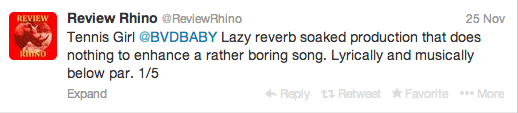
Here is Review Rhino’s review of the band’s song “Tennis Girl”:

Screen Shot 2013-12-19 at 7.30.44 AM

Now, that might seem like a harsh review, but there are a couple of factors one needs to take into account.  Firstly, Review Rhino has 140 characters by which to mention the track name, the band, a brief review, and then give a numerical score.  There’s no pussyfooting around because there’s no space for Review Rhino to gently say “I don’t like your song.”  The second thing that you must consider is that Review Rhino does not seek out songs to review, instead bands willingly send their songs in for review.  As you can imagine, Black Vendetta weren’t thrilled by the review, but the band really got upset when Review Rhino tweeted his “best” and “worst” tracks of the month:

Screen Shot 2013-12-19 at 7.34.27 AM

Now, even though I don’t want to side with someone complaining about a bad review, I can see Black Vendetta’s point.  I struggle to keep it positive here at Defending Axl Rose, and tend to shy away from things like “worst of” lists because it’s easier to just be positive.  That said, I can see Review Rhino’s point of view, too.  The market is saturated with a lot of mediocre, delusional people making a god-awful ruckus.  For the record this is how I got involved:

Screen Shot 2013-12-19 at 7.49.37 AM

There’s a lot more after that, Black Vendetta goes on and on about how unfair it is to pick on unsigned bands.  He/she/they also take time to point out that they have a degree in journalism…it’s really very unfortunate.  This is the part of being a critic that’s a frankly a little scary to me.  I’ve been getting lots of requests to review things lately, and some of what people want me to review/write about isn’t very good.  Unlike Review Rhino, I don’t have the stones to play Simon Cowell and crush someone’s dreams.  Don’t get me wrong, I have no problem telling you that the latest Megadeath album is an utter piece of garbage.  Or that I have desperately tried and failed to listen to all of Black Sabbath’s latest album 13 more than thirteen times.  I’m just not sure I could tell that to an unsigned indie like Black Vendetta.

However, as the saying goes: there’s no such thing as bad publicity.  This Twitter thread got me interested in Black Vendetta’s song “Tennis Girl.”  So I fired up Spotify to see if the band was streamable, and sure enough they were! So I listened to “Tennis Girl,” and so can you! I’d like to give the band a chance and put it to a Highly-Unscientific Rock Poll: Does “Tennis Girl” by Black Vendetta suck or not?

Tagged , , , ,