Category Archives: Album Reviews

Classic Albums Revisited: IT’S HARD

The second album following the death of drummer Keith Moon, and the last until 2006’s ENDLESS WIRE, The Who’s album IT’S HARD isn’t as highly regarded as the group’s late 60’s and 70’s output. Released in 1982, the band wasn’t considered “relevant” anymore by most mainstream rock critics. Radio stations and casual music fans greeted IT’S HARD with ambivalence when it came out, and the album languished at #11 in the UK and #8 in the US. Of course, most bands would kill for their album to reach #8. But IT’S HARD wasn’t released by “most bands,” it was put out by the legendary Who (or what remained of them).

“He’s an Atari Wizard, there has to be a trick…”

A few years ago I got into this phase where every time I took a long car-trip I’d go buy a Who album to listen to while I drove. After a few long-ass car rides I’d purchased just about every single Who album, except for FACE DANCES and IT’S HARD. I chose IT’S HARD over FACE DANCES because I’d heard “Eminence Front” on the radio growing-up and remembered liking it.

Despite being deemed a failure upon it’s release, I found IT’S HARD to actually be not only a pretty solid late-period Who album, but actually a pretty good Who album-overall. IT’S HARD is an extremely passionate record. Roger Daltry is no slouch when it comes to conveying emotion through his legendary rock-howl…but on IT’S HARD his voice is downright visceral.

I also read a review somewhere that said the album was full of complex songs with meandering structures that, for the large part have no strong melodies. I agree with some of that. The songs do have long, almost prog-rock like structures, but this enhances the album and is a detraction. I will admit that the hooky lyrics and melodies of the early Who albums aren’t as strong here. But what the album lacks in “hooks” and choruses you can instantly sing along with, the album makes up in passion.

The album’s two singles–the before mentioned “Eminence Front” and “Athena,” aren’t really very reflective of the album as a whole. Whenever this happens (a band’s single not representing the bulk of an album’s content), that artist is nearly always in trouble. Perhaps the main record-buying public balked at IT’S HARD because of “Athena” and it’s bubbly, adult-contemporary-ness. Serious Who fans who were floored by the groovy white-guy soul (that only Brits can pull off) of “Eminence Front” were probably turned off by the rather non-groovy white-guy soul of the rest of the album. Both groups are hard to please, but with the passage of time and absolutely no expectations I walked into this album complete and utterly shocked. And amazed.

As stated earlier, this is a record dripping with passion, and passion and politics go hand-in-hand. No stranger’s to politics, The Who once again dabble in fiery protest rock with “I’ve Known No War.” Equal parts anti-war/pacifist, this song chillingly points out that even if a person doesn’t want to fight in the great war it won’t matter…because the next great war will be fought by two people with there fingers on “the button.”

Also political, is “Why Did I Fall For That?” which seems to directly answer the band’s earlier “Won’t Get Fooled Again.” Listening to this song reminds me some of my relatives who voted for the current president…then voted for him the second time. The song reminds us that history will hold ALL of us accountable for falling for the same old line time and time again. In other words, twenty years later, it STILL touches a nerve. That, my friends, is awesome.

The album’s title track is fucking amazing. It’s completely 100% classic Who. It has the nice, rollicking guitar. It has the pounding drums. It has the classic Who-background vocal-chant. The lyrics, while a little cumbersome at times are still pretty good. Who (not the band) after a particularly bad day hasn’t asked the heavens above to be dealt a better hand? The Who (band) have:

“Anyone can do anything if they hold the right card
So I’m thinking about my life now
I’m thinking very hard
Deal me another hand Lord, this one’s very hard
Deal me another hand Lord, this one’s very hard”

The guitar work on this record, while a little more restrained (compared to previous Who records) is still very good. I’m not a fan of the ridiculous Rocky-Theme-sounding horns at the beginning of “One At a Time.” These horns were never cool, not even in 1982. Crappy horns (they’re seriously only there for like 5 seconds) aside, “One At a Time” is actually a pretty good song, in the same vein as “Squeeze Box” and “You Better You Bet.”  But my biggest gripe I have about IT’S HARD is that it’s production is a bit dated (read: sounds like the 1980’s) and the band uses a bit too much synthesizer for my taste. I’m sure at the time; this wasn’t as big an issue as it is now. Like black and white film, the sound of a synthesizer really turns a lot of young people off. To be fair to The Who, IT’S HARD makes good use of the synthesizer. Still, I think the production/synthesize-issue are the two main reasons this record’s reputation takes such a hit compared to the bulk of the Who’s recordings in many people’s esteem.

Despite a lackluster public and critical reception, IT’S HARD is actually pretty fucking amazing now that I think about it. Next time you find yourself about to listen to WHO’S NEXT, TOMMY, or (if you’re really cool) QUADROPHENIA, pop in IT’S HARD instead. This album demands a second (or third, fourth, etc.) listen.

Tagged , , , , , , ,

Your Next Favorite Band: Jellyfish

They say that stars that burn twice as bright burn half as long.  I want to introduce you to a really amazing power-pop band from the 1990’s, but before I do I must warn you: they only put out two records.  If you’re the kind of person that obsesses over really awesome shit that never got its proper due, maybe you should sit this one out.  Jellyfish was a band that I grew up with and to this day I still love them and smile whenever I hear one of their songs.  I’ve met precious few people who’ve even heard of them (or can remember them) and that’s a real shame because they put out two damn near perfect records.

A word about “power-pop.”  I really feel stupid using that term and not just because it sounds like a super-caffeinated soft drink.  In general, I really dislike the concept of “genre.” But I must admit that it does serve as a nice bit of short-hand when you’re trying to talk to people so I’m going to use the term “power-pop.”  Power-pop is basically rock music that features strong lyrical hooks and big guitar riffs.  Melodies and harmonies are also really important in power-pop.  A lot of the British invasion-era rock could be considered power-pop, but for the most part the term is applied to bands that came after/were influenced by those bands.  So The Beatles are not considered power-pop but Badfinger (who came later and are basically the same band) are power-pop.

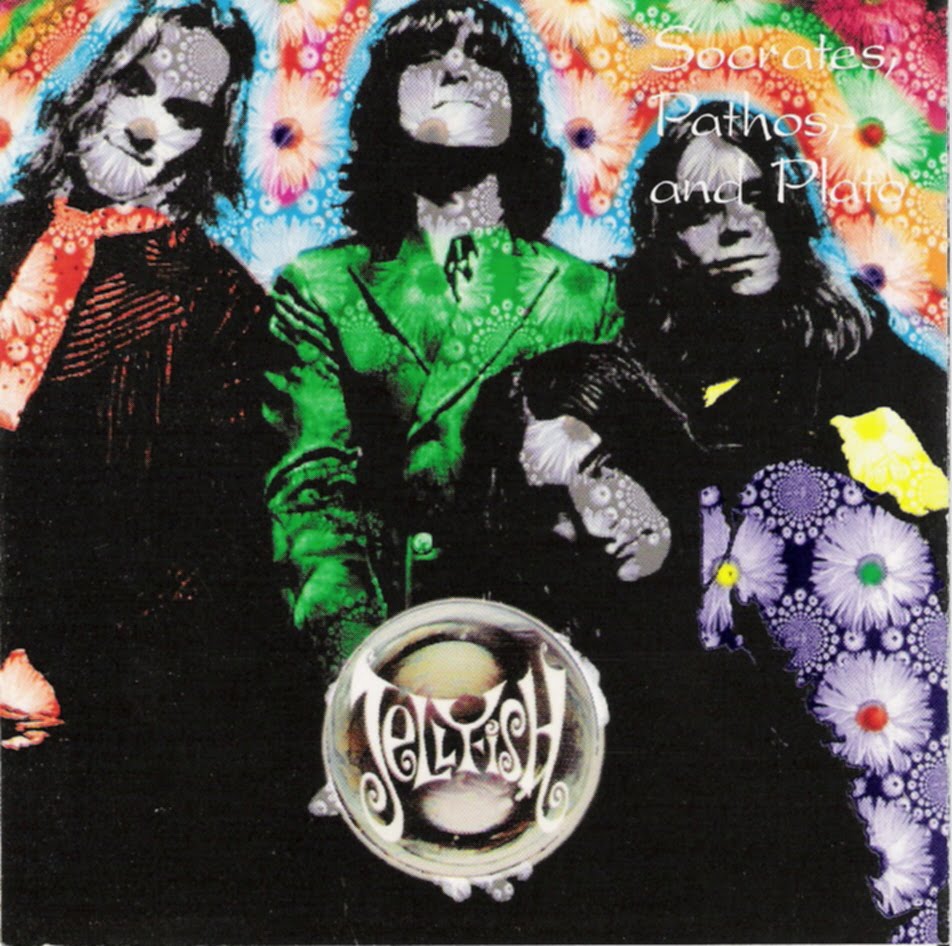
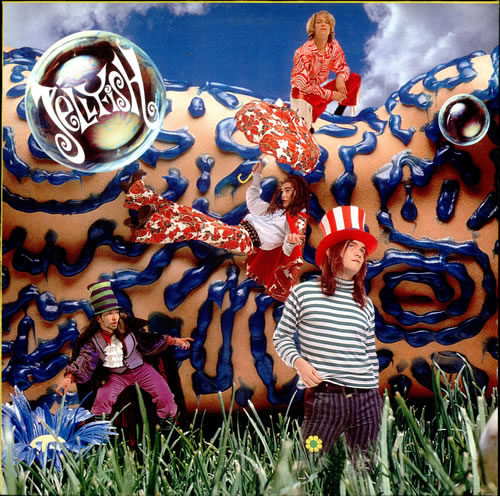
BELLYBUTTON-era Jellyfish. Awesome musicians with terrible fashion sense.

Jellyfish was formed in 1989 in San Francisco, California. The band had several members over the years but the foundation of the band was two super-talented, multi-instrumentalists: Andy Sturmer and Roger Joseph Manning, Jr.*  Andy was primarily the drummer and Roger played keyboards.   For their first album, Roger and Andy were joined by bassist Chris Manning a duty that was also shared by Steven Shane McDonald (of Redd Kross-fame, another great power-pop band from this era) and guitarist Jason Falkner.  To say that these  lads had talent is the worst kind of understatement–there really were four geniuses in the band. And while that helped make the first Jellyfish album, BELLYBUTTON, an instant-classic…it also lead to a lot of tension.

BELLYBUTTON came out in 1990 and was met with moderate success.  The album spawned three singles, “The King Is Half-Undressed,” “That Is Why,” and “Baby’s Coming Back.”   Some quirky music videos and a funky day-glo image helped get people’s attention, though the band was never a true household name.  BELLYBUTTON’s sound is one of lush harmonies and catchy-as-hell choruses.  The Beatles and Beach Boys are all over this record (they even mention The Beatles by name in  “All I Want Is Everything”). And while the band doesn’t ever quite go full-on psychedelic, they get close.  It’s a bit difficult to say “this is what Jellyfish sounds like” because like late-period Beatles (and super-druggy Brian Wilson), Jellyfish experiment with different sounds and instruments.

Among the kaleidoscope of 1960’s-ish sounds there are are two really nice ballads, “I Wanna Stay Home” and “Calling Sarah.”  “I Wanna Stay Home” in particular almost sounds like it belongs on a totally different record.  It’s a very sincere song that’s about having to go even though you just want to say home.  The very next song “She Still Loves Him” is a haunting tale about an abusive relationship, it’s a great song, with some really sharp lyrics and an awesome guitar solo…but it also feels very odd after “I Wanna Stay Home.”  BELLYBUTTON, while a fantastic record, is not a unified work of art.  Instead it’s more of an awesome Frankenstein’s Monster of a record, with a bunch of really awesome bits sown together.   There are a ton of really nice little details that really don’t appreciate on the first few listens.  Some of my favorites include: the nice trumpet part at the beginning of “Bedspring Kiss”, the faux-live effect/crowd sound on the Cheap Trick-like “All I Want Is Everything”**, and the dreamy piano noodling that plays before “She Still Loves Him.”

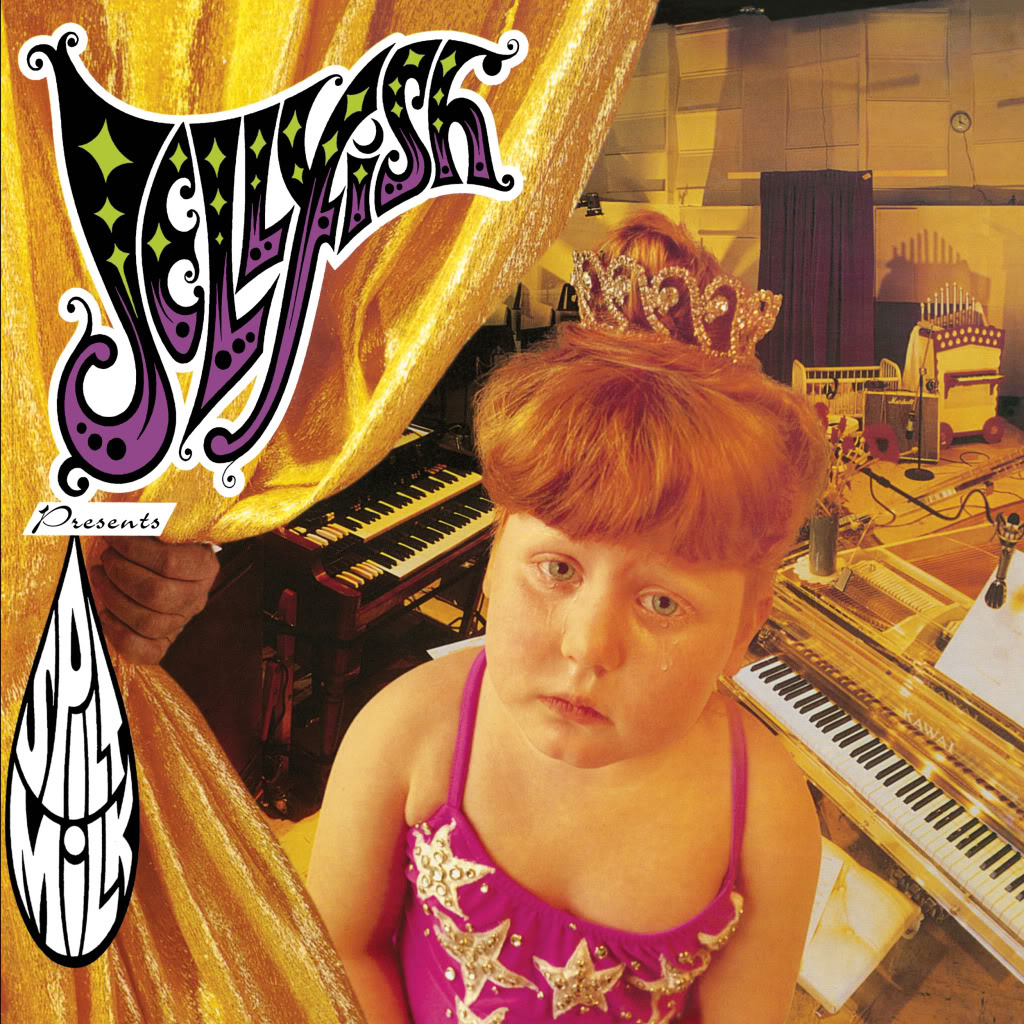
In 1993 the band put out their second album SPILT MILK.  This album sadly did not feature most of the band from the first record–gone was everyone but Sturmer and Manning Jr.  A new bassist, Tim Smith, was added to the mix along with a few session guitarists.  Despite the change in personnel, I actually prefer SPILT MILK and think it’s the stronger of the two records.  SPILT MILK is interesting because Jellyfish takes the 1960’s British-Pop aesthetics of BELLYBUTTON and apply a thick coating of Glam Rock.  What you get is something that sounds like Queen-by-way-of-The Beatles.  Oddly enough, despite losing their guitarists, SPILT MILK also has way better guitar parts/solos, though Roger Manning’s keyboards do wind up taking a more prominent role.  SPILT MILK is full of such dualities: it’s a keyboard album with awesome guitars, dark and angry but has a playful song about masturbation (“He’s My Best Friend”).

The album opens with the quiet, lullaby-like “Hush” which ironically leads into the explosive “Joining A Fanclub.” I can’t say enough about how awesome “Joining A Fanclub” is.  Ostensibly about the dangers of stardom and hero worship, the songs is a really headbangger.  It’s the kind of song you hear while driving and it causes you to get a speeding ticket.  Every time I hear it I think about Robert Downey Jr. (who at the time this song was written was constantly getting into trouble with the law).  I also really love “New Mistake” with it’s twisty-lyrics about an “oops” pregnancy–the best part? At the end the baby grows up and marries a pop singer (because it’s time for her to make her “first mistake.”).  This is the kind of song that keep me up at night it’s so awesome.  I almost don’t believe it was crafted by mere mortals.  I also can’t help but marvel at “The Ghost Of Number One” which seems to poke fun at the fact that the band knew that they weren’t going to reach the level of success that they deserved.

Like BELLYBUTTON, Jellyfish’s second record also features some interesting experimentation. I’m confident that I’d never been exposed to Klezmer music*** before I heard “Bye Bye Bye.”  That song alone is worth the purchase price of the album, it’s simply a stunningly awesome song, and was definitely not something you heard on the radio in 1993 (or hell today for that matter).  The album ends with the magnificent, circus-themed “Brighter Day.” The song is a fantastic way to close the record and unfortunately the recording career of Jellyfish.  And when it ends all you want to do is start the whole thing over again. 

So what happened? Well a lack of success and bruised egos led Jellyfish to die an unglamorous death, alone and relatively unmourned.  Jason Falkner and Roger Joseph Manning, Jr. both have had relatively successful solo-careers (Falkner in particular has recorded some amazing records).  Lead-singer Andy Sturmer gave up being in bands and is how a producer.  Over the years the band has developed a somewhat cult-following online.  I wrote my one and only Wikipedia entry in 2006 when a greatest-hits compilation called BEST! was released.  It’s not a very long article, more like an album stub but for some reason I felt compelled to write it.  Jellyfish is one of those bands I simply can’t imagine living without and it bums me out that so few people are aware of them.  I highly, highly recommend Jellyfish. 


ENDNOTES:

*Fun fact, the “Jr.” had to be added to Roger’s professional name because it turned out there already WAS a semi-not-really famous musician named Roger Joseph Manning.  What are the chances of such a thing?  Now go win that super-obscure power-pop bar-trivia.


**It sounds like LIVE AT BUDOKAN, get it?


***Jewish Eastern European music. It’s as awesome as it sounds. 

Tagged , , , , , , , , , , , , , , , , , ,

Gringo Star vs. Ringo Deathstarr

Last night I went on a Magical Mystery Tour deep within the bowels of Spotify.   I do this thing I call “band hopping” where I’ll listen to something and then let Spotify recommend something.  After I’m done listening to that I let it recommend something to me based on THAT song…pretty soon I’m completely and utterly lost.  I wish I could remember what led me to down the weird rabbit-hole of bands named in honor of ex-Beatle Ringo Starr, I bet the trajectory of songs was pretty interesting, but alas…I was in offline mode and my listens were not recorded.

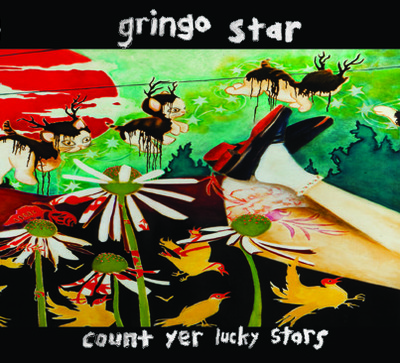
But I digress.  The important thing is there are two really awesome rock bands with Ringo-inspired names.  The first of these bands that I happened upon was Atlanta-based Gringo Star.  What do you think of when you read that name?  I bet you think Gringo Star is a Beatles-inspired pop-rock band, right? I know that’s what I was thinking.  Turns out Gringo Star is a really cool rock band with some British-invasion influences, but mostly is a bit like the UK’s Supergrass.  The band’s latest album COUNT YER LUCKY STARS is a pretty tight collection of rock songs with a lot of “ooh’s” and “ahh’s.”**

I’m counting ’em…

The album opener “Shadow” invokes both the aforementioned Supergrass as well as Oasis, Blur, with just a hint of Dr. Dog (great harmonies).  The album is full of great songs, but I really like the spanish-influenced “Esmerelda” and the dreamy album-closer “Mexican Coma.”  That last song in particular sounds like it could have been a hit in 1966 by song little-know, post-Beatles invasion-era rock band.  I can almost see the vinyl copy of “Mexican Coma” by The Mudd Turtles or some such thing. It’s a really nice summer chill-out song, with a super-cool guitar solo.  But the song the changed my lust to love was “Got It,” which sounds like an early Kinks single.  It’s got a real nice, super-catchy hook that just digs into your brain and won’t let go.  Right now “Got It” is near the top of the list of best songs I’ve heard this summer (woah! It’s only June) .

From Gringo Star I ended up listening to a band called Ringo Deathstarr.  As far as jokey names go, Ringo Deathstarr beats Gringo Star hands-down.  Besides having the proper number of “R’s” in “Starr” the band’s name is also a freaking STAR WARS pun.

Super-washed out colours.

Now Ringo Deathstarr is a COMPLETELY different animal.  For one thing, their album COLOUR TRIP is more acid/reverb drenched than Gringo Star’s super-crisp rock.  Hailing from Texas, Ringo Deathstarr sounds a bit like The Flaming Lips by way of The Cure.  The band is a girl-and-guy “shoegaze” band that I have to reluctantly admit to being a sucker for. COLOUR TRIP opens with the spaced out “Imagine Hearts” which is a joyous bit of pop.  The album’s best track is “So High,” which sounds how a whacked-out day at the beach feels.  The gentle “Other Things” closes the album with bittersweet introspection.  It’s the kind of song that’s easy to get lost inside.  Some bands exist in space and other create it, and Ringo Deathstarr definitely create their own space–COLOUR TRIP is best enjoyed alone with headphones.  

Both bands (and albums) are pretty awesome, and despite sharing similarities in their name they’re pretty far apart sonically.  For me, Gringo Star has the better songs and Ringo Deathstarr has the better vibes.  Is that a cop-out? I guess, but it’s really like comparing apples to oranges.  Check ’em both out and tell me what you think.

FOOTNOTES:

**TANGENT: I think that modern music needs more “ooh’s” and “ahh’s.”  Go back and listen to music, from all genres, of the last 50 years and you’ll hear a ton of “ooh’s” and “ahh’s.”  But with only a few notable exceptions, COUNT YER LUCKY STARS being one of them, I can’t recall very many bands/albums today that use “ooh’s” and “ahh’s.”

Tagged , , , , , , , , ,

Boxer The Horse & FRENCH RESIDENCY

I first discovered Canadian Indie-rockers Boxer The Horse last year while browsing eMusic.   I really dug their awesome first album WOULD YOU PLEASE, especially the song “Bad Apples” which was one of the best songs I heard last year.  I played it countless times (so many times I literally lost count).   So as you can imagine I was pretty stoked when I found out that the band released a new album this week.  Boxer The Horse is a bit like the films of Wes Anderson–you’ll either dig their somewhat twee-sensibilities or you’ll loath it.  Their songs are carefully constructed, literate, and despite having a shiny-pop veneer are often pretty dark.  

FRENCH RESIDENCY finds the band improving and growing in just about every sense–the songs are better, the hooks are hookier,  and the songs are longer/more fleshed out.  One of the things I really like about Boxer The Horse is how diverse their albums sound.  They do spooky-indie pop (“Me & Steve McQueen”), straight out rockers (“Rattle Your Cage”), a kind of neo-folk (“Tough Luck”), and punk (“Bridge To The USA”).  I think it’s cool that the band does what they want genre/conventions be damned.  That said, I  can see how this might come across as a bit schizophrenic to some, and might even be considered a weakness for those who need everything carefully slotted into neat categories.  Regardless,  I find it refreshing and I’m sure this diversity makes them one helluva live act.

The best song on FRENCH RESIDENCY is “Rattle Your Cage.”   It’s that awesome brand of hard-charing pop song  the radio used to adore when we were kids, it’s shocking how good it is.  It reminds me of ROOM ON FIRE-era Strokes (that’s a good thing).  I love the hook, the guitars, and the awesome way the song collapses at the end.   “Rattle Your Cage” is the sort of song that demands to be played in an arena.  On the other end of the spectrum is “Me & Steve McQueen” which is quiet and intimate, almost anti-arena rock song.  It’s a murky, mysterious ballad that materializes and then quickly vaporizes like a ghost.  It’s less than 2 minutes of bliss.

I love that the laid-back “Tough Luck”  leads into the aggressive “Bridge To The USA.”  It’s a thoughtful bit of album construction that you don’t see much of these days.  The song “T. Rex” won me over as I was typing this review with the hilariously spot-on lyric: “don’t look so depressed on a Sunday morning /well don’t act like such a slut on Saturday night.”  That’s a Fagen & Becker-ish bit of cattiness I can’t help but love. The album is filled with little nuggets and flourishes that really impress and reward repeat listens.  I’m also intrigued by the fact that there’s a darkness lurking just under the surface throughout FRENCH RESIDENCY.  It reminds me of the way a lot of John Lennon’s solo albums felt.

Bad Apples, the whole lot…

That’s not to say that everything is perfect on FRENCH RESIDENCY, it’s not.  There are a few tracks that only-half work for me, the biggest offender being the Vampire Weekend-like “Party Saturday.”  It’s a bit too cute, even for me (though it does have a nice guitar solo).  “Karen Silkwood” is the other song on the record I just can’t get behind.  It’s so damn bizarre, lyrically, that I think I’m going to have to listen to it a few more times before I can figure out what it’s trying to say (if it’s trying to say anything).  A quick Google search reveals that Karen Silkwood was an Oklahoma labor activist who died under mysterious circumstances in 1974.  With that in mind, the song “Karen Silkwood” opens thusly: “I’m in the car when Karen Silkwood was killed / Texas Ranger won’t you marry me still?”  I’m all for complex lyrics and interesting narratives, but that’s just strange to be strange, right?  Speaking of odd things, I noticed after a few listens that there are multiple references to blood and bleeding scattered throughout the album.  I can’t say for certain, but I think this might be a subconscious-tic on the part of the band.  I know that as a writer there are some words and phrases I will use repeatedly if I’m not careful.  I wouldn’t be surprised if no one in the band was aware of this.

Historically, the second album is the one that separates the men from the boys.   FRENCH RESIDENCY is not a just an excellent sophomore album, it’s an excellent album in general.  It proves that WOULD YOU PLEASE wasn’t a fluke, but rather the beginning of an exciting career.

Tagged , , , , , , , , ,

Classic Albums Revisited: SOLO IN SOHO

A lot of people have the wrong impression of Thin Lizzy.  They weren’t the dunder-headed hard rockers that people think they were.  Thin Lizzy were rockers with heart.  And that heart came from lead-singer/songwriter Philip Lynott.  When a songwriter is dubbed a “poet,” I can’t help but think of doilies and Shakespeare…the truth this, a poet is someone who can take complex feelings and distill them in way just about everyone can understand.  It’s more than just pretty words.  I can write about love and explain it to you, but only a true poet will be able to not only describe love but also convey the feeling of love.  Phil Lynott was a poet and there was nothing stupid or dunder-headed about his work.

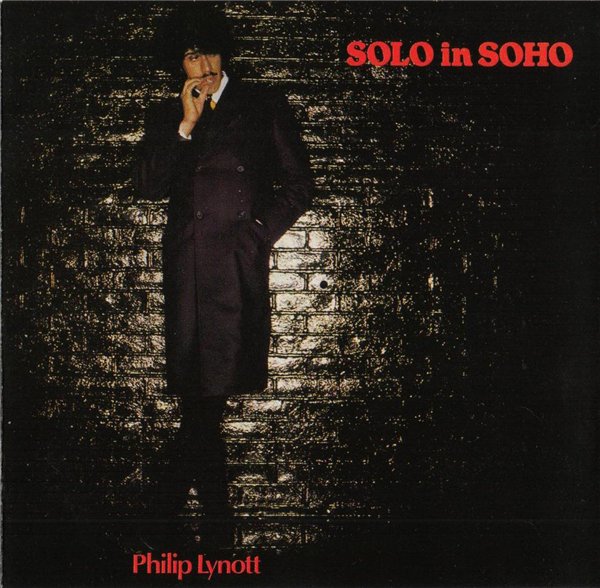
Thin Lizzy exploded when they released JAILBREAK in 1976.  They’d been doing their thing for a while but it was that album that put them on the map with songs like “Running Back,” “The Cowboy Song,” and of course “The Boys Are Back In Town.”  That last song in particular doomed Thin Lizzy by both setting their expected level of commercial success higher than the band could ever reach again while also providing Thin Lizzy with the means to indulge their bad habits*.  Just before Thin Lizzy called it quits, Lynott started his solo career.  His first album, SOLO IN SOHO, was released in 1980.  I think the album is a both astonishingly diverse and heartbreakingly sincere.

NOUN: A thing done by one person unaccompanied, in particular.

The first song, “Dear Miss Lonely Hearts” sounds like it would fit nicely on just about any Thin Lizzy album (which makes sense considering that Lynott’s backing band consisted of most of Thin Lizzy, along with Mark Knopfler from The Dire Straits, and oddly enough Huey Lewis on harmonica).  I really like this song, which is an awesome rocker about a guy who writes an advice columnist when he falls in love with his girlfriend’s sister.  As trashy and, frankly ridiculous, as that sounds “Dear Miss Lonely Hearts” doesn’t come off silly at all.  Lynott switches perspective back and forth during the song from the author of the letter and the titular “Miss Lonely Hearts.”  The ever complex and sensitive Lynott seems to sympathize more with women in the song than the confused Casanova.   

“King’s Call” is another song that sounds like it could have appeared on a Thin Lizzy album.  It’s a poignant song about the singer’s reaction to the death of Elvis Presley.  Listening to this song today, one can’t help but draw an unfortunate parallel to Lynott’s own death in 1986.  It’s especially difficult to hear him sing about drinking “a bottle of wine and gin” when Elvis dies (Lynott died of complications from substance abuse). The song is bittersweet, however, because as Lynott attests in the song, “You can always hear the King’s Call” can also apply to Lynott and the amazing work he did.  I also find it a little funny that a ballsy rocker like Lynott so idolized Elvis.  I think a lot of people from my generation tend to under-appreciate Elvis and his cultural significance.

The rest of the album departs from what many would expect to hear from the lead-singer of Thin Lizzy.  “A Child’s Lullaby” is just that, a lullaby to Phil’s daughter Sarah.  The lyrics, which are simple but clearly from the heart,  are beautifully paired with an orchestral arrangement that’s as delicate as Lynott’s vocals.  I can’t think of a song further from “The Boys Are Back In Town,”  and it a way it bums me out that this side of Phil Lynott is not the one people remember the most.  As raucous and rebellious as Thin Lizzy was, Lynott was big softie at heart.   “Tattoo (Giving It Up All For Love)” is a super-catchy R&B number that also should have been a monster-hit**.  “Girl” is another R&B-like departure which manages to defy Lynott’s tough-guy/Thin Lizzy image.  Worth noting is the fact that this song, and “Solo in Soho” both feature a really weird spoke-word segment by this British woman who sounds a bit like a robot.  I’d say that that this one detail is the only blight on an otherwise awesome record (this woman does not know what “emote” means and speaks in the flattest possible manner).

SOLO IN SOHO is noteworthy for addressing the subject of race, something not really touched upon by Thin Lizzy.  On “Ode To A Black Man” Lynott seems both angry and filled with pride about being black.  It’s funny, but I never really thought about Lynott’s race growing up, he was just the dude from Thin Lizzy…but Lynott wasn’t a white guy.  I won’t pretend to understand the complexities of coming from a racially mixed background (especially during the 50’s and 60’s when Lynott grew up) but I find “Ode To A Black Man” fascinating.  It makes me wish Lynott had written more songs about his experiences of being black.

Blinded by Rock? Can you believe I never gave much thought to Lynott’s racial background?

“Yellow Pearl” is an awesome and a bit baffling bit of techno-pop.  It’s pretty much as far from Thin Lizzy’s classic rock sound as one can get, and yet it’s pretty fantastic in it’s own right.  I’ve listened to this song a few times and I’ll be honest…I have no idea what this song is about (if you know congratulations, you’re smarter than me, please tell me in the comments below).  It’s trippy and cool and ahead of it’s time/completely awesome, you really need to experience it for yourself.  The album ends with “Talk In ’79” which is an almost spoken-word piece about the music scene at the time.  As a piece of history it’s interesting, as Lynott name-checks Brian Eno, The Police, and Rockpile of all things.  In the last line of the song Lynott mystically says:

“This broadcast was brought to you in 1979

I’m just talking to you over these waves

Not just another time and another place

And before we knew it

The old wave was gone and controlled.”

An interesting fact that people don’t know about Phil Lynott is that he was friends with The Sex Pistols and was a champion of the early punk scene.  I find this curious because those same punk-rockers would be the same people who would eventually turn the tide against rock bands like Thin Lizzy.  “Talk In 79” seems like a critique on both the music press and the music “scene” in general.  I wish Lynott hadn’t died because I’d like to know what his reaction to music press in the digital age.  Genres are more splintered and the audience is doubly fickle.   An artist like Phil Lynott probably wouldn’t have been allowed to flourish and mature.  I can’t imagine an album like SOLO IN SOHO coming out today.  Lynott was a well-established artist but based on his previous work with Thin Lizzy, SOLO IN SOHO was a gamble.  Sadly, the album isn’t very easy to find today.  I wasn’t able to download it on iTunes or stream it on Spotify.  My local record shop didn’t have a copy, either, so the only way I was able to get my hands on it was to buy it from Amazon as a (gasp!) physical CD.  I find that a shame because there is so much good stuff on SOLO IN SOHO.  If you’re in a second-hand record shop and you see SOLO IN SOHO pick it up, it’s a fantastic record by an often overlooked artist.

FOOTNOTES:

*Both musically and pharmacologically.

**Interestingly enough, “Tattoo (She’s Giving It All Up For Love)” was covered by Huey Lewis & The News on their 1982 album PICTURE THIS.

Tagged , , , , , , , , , , , , , ,

THAT’S WHY GOD MADE THE RADIO

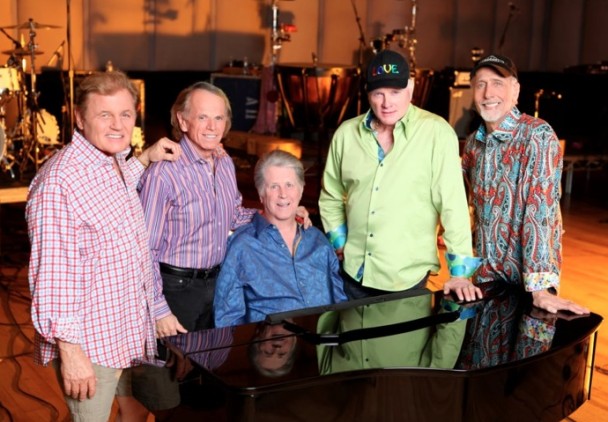
Upon first hearing that the newly re-formed Beach Boys were recording a new album all I could do was smirk. Not in the playful, nice way but in the jaded slightly/evil manner. I didn’t want them to fail in their latest creative endeavor, I was just highly skeptical. The notion of 60+ year-old men still calling themselves The Beach Boys is pretty stupid if you think about it. These aren’t boys, not by a long shot. They’re not even just The Beach Men at this juncture–they’re The Old Beach Men. There’s been a lot of classic-rock bands reuniting (Black Sabbath, Van Hale, et. al) and thus far the results have been predictably mixed. Making matter’s worse is the fact that The Beach Boys have always had a checkered discography, and that’s being kind.

They did it! Those crazy son-of-a-bitches did it.

But before I get to The Beach Boys latest record, THAT’S WHY GOD MADE THE RADIO (and my reaction to it), I’d like to take a moment to analyze why a band as historic and venerable as The Beach Boys would feel the need to lay it all on the line and record new material. I mean, at this point they can only lose, right? At a certain point our heros are only capable of failure, aren’t they? Brian Wilson could have ate/snorted himself to death after PET SOUNDS came out in the late 1960’s and I’d still think he was a genius. He didn’t need to come out of reunite to prove anything*. And if the album is bad, if THAT’S WHY GOD MADE THE RADIO turned out to be a festering pile of shit his stock would plummet. PET SOUNDS would still remain but now I’d have this nasty (much fresher) taste in my mouth. As a true fan, I can forgive and ignore my heroes latter-day misses…but the greater music-listening public is much more fickle. And far less forgiving. Stumbling at this point in the career of The Beach Boys might not take away all the shine, but it could seriously tarnish their legacy. I guess the reason why these so-called dinosaurs of rock try to knock one last homerun out of the park is simple: it’s because they can. Sure, money and ballooning mortgage payments are probably a factor. And I suppose a bunch of snot-nosed, spoiled to-the-core-grandkids probably play a part, too. But in the end, Brian Wilson and Mike Love are writing and recording new material because they can. Think about how awesome that must feel–all you have to do is pick up the phone and tell an agent/record executive, “We want to do a new album” and the keys to kingdom are instantly yours, no questions asked. I would say that 99.999% of the artists living in the world today do not have that kind of clout, but would KILL to have that kind of capability. On a certain level I think it’s disrespectful when artists in this position chose to not use this freedom.

So while I’m sure ego and finances have some part in why I now get to write a review of brand-new Beach Boys record, I don’t think that’s the whole story. I think The Beach Boys like being The Beach Boys. And somehow they were able to put aside the bullshit and do what they should have been doing for years; what they were born to do which is write and record pop music. Now that said, before we envy them too terribly much, I think it’s worth pointing out that being The Beach Boys is probably the only thing these old men are really good at doing. From what I’ve read of Brian Wilson’s personal life, being a Beach Boy is pretty much the only truly great thing he ever did. His life, at least until recently (give or take a decade) has been a great shambling train-wreck (I’m looking at you Wilson-Phillips). His music, even as a solo artist has been pretty spotty; being a Beach Boy is his saving grace and ultimately his legacy. I don’t feel that any of us should worship or feel sorry for him (or any of them). Just like I am right-handed and bad at math, Brian Wilson can write fucking amazing melodies and compose beautiful arrangements. It’s not something he chose it’s just how he was made/what he is.

Okay, so I don’t think The Beach Boys set out to merely cash-in on their name (and it’s glorious bag of nostalgia). And I recognize they had more to lose than gain with releasing THAT’S WHY GOD MADE THE RADIO…that’s all well and good but what do I think about the album? Well for starters, after I got over my bemusement over the fact that they’re still called “The Beach Boys,” the next thing that happened when I heard about this album was that I cringed. I cringed at that awful title. “That’s Why God Made The Radio”? What the hell does that mean? Are The Beach Boys saying that they’re the reason God, THE LORD ALMIGHTY made the RADIO!? I was really nervous as it seemed I they band might have finally gone off their rockers. The hubris I read into the title was thankfully misinterpreted. The title referes to the song by the same name that extolls the bliss of driving around and listening to the radio. “That’s Why God Made The Radio” is a song about a joy that few people of my generation can even comprehend. I won’t say that I forgot about how nice it is to drive around and enjoy the radio, but I hadn’t done it for awhile. Listening to this song made me put the FM back on in my car (that’s a good thing). The song is a basic ode to rock ‘n roll as well. It actually reminded me (a bit) of Argent’s “God Gave Rock ‘n Roll To You” which is another song about thanking the cosmic creator for musical bliss. “That’ s Why God Made The Radio” is a good song and when I heard it my hopes instantly rose for the rest of the album.

In fact, to my surprise, this album turned out pretty damn well. It doesn’t really add or subtract to the legacy of The Beach Boys, but we do get a couple of really good songs (and two fantastic ones). The first fantastic song on THAT’S WHY GOD MADE THE RADIO is the third song on the album, “Isn’t It Time.” Mercifully credited to the ENTIRE band (The Beach Boys have a nasty history of not giving credit where credit is due) this song is worth the price of the album. On one level it’s a typical (stereotypical?) old-man rock song about how great things used to be and how they can still be great again. I guess on that level it’s an okay song, but as I listen to it, I can’t help but hear The Beach Boys responding to my initial question of “Why did The Beach Boys record a new album?” The answer comes in the lyrics of the third verse:

“The good times never have to end

And now’s the time to let them happen again

And we can have ourselves a blast

The good times they aren’t only in the past”

The sentiment is pure and even though it might be bullshit, I believe it: today can be just as good as yesterday (or whatever day was the best time of your life). To hear older people proclaim this is terribly comforting, especially to this eternal pessimist. This is what great art does, it acts as a buoy for our spirits.

The next track “Spring Vacation” also attempts to explain more concretely how the band reconciled and got back together (all those decades apart were just a super-long winter, I suppose). Maybe I’d dig this song more if it didn’t immediately follow “Isn’t It Time.” “Spring Vacation” doesn’t make my eyes well-up with emotion like “Isn’t It time,” but it’s a decent song I suppose.

The second fantastic song on THAT’S WHY GOD MADE THE RADIO? This difficult for me to write, as I feel so damn conflicted about it. You see, I’m the sort of Beach Boy fan that likes PET SOUNDS and hates “Kokomo.” If you’re reading this and you like “Kokomo” you’re a terrible person. “Kokomo” is a horribly shitty song. It comes from a dark, dark period in Beach Boys history. The period where Brian was cast off and that bastard Mike Love was running the show, trying to cash-in with a quick-hit. Somehow he lucked out (scum always does float to the top, doesn’t it?) and “Kokomo” got slapped into a movie and it took the world by storm (a shit storm). Anyway I want you to understand that I don’t like Mike Love on a personal level. Everything I’ve read about him paints a picture of a spineless, manipulative, little Napoleon who took advantage of a fragile/abused person (B. Wilson) in order to profit.** So what has Mike Love done on THAT’S WHY GOD MADE THE RADIO? He’s essentially reworked “Kokomo” as a new track, “Daybreak Over The Ocean.” I knew it from the very first second I heard it. I thought “Holy shit, he’s trying to recapture that hit…he’s trying to do another Kokomo.”

That dick.

And then I listened to it again. And again. And again. Shit, it’s a damn good song. I want to hate this song, but “Daybreak Over The Ocean” makes me love it despite myself. The production isn’t as crappy as the 80’s “Kokomo” and the emotion seems (a bit) more genuine…but it’s essentially “Kokomo.” The way-less-shitty version of “Kokomo.” And even though I don’t like Mike Love, and I detest “Kokomo” I think “Daybreak Over The Ocean” is THAT’S WHY GOD MADE THE RADIO’s other truly amazing song.

The rest of the album is fair, with only two borderline embarrassing songs (which is actually really good for a Beach Boys record). The first dismal track is “The Private Life of Bill and Sue” which is comically-late attack on reality TV. The song smacks of trying to way too hard at be relevant/. The only way it could have been worse would be if they had rapped the song. Maybe they’re saving that for the next album. The other cringe-inducing moment is “Beaches In Mind” which is not only super-vanilla but littered with the word “fun.” I don’t know about you, but hearing the word “fun” is not the same as having fun. It doesn’t really tell me anything, it’s like “nice.” What the hell is nice? “Beaches In Mind” feels like filler which makes it the more noxious of the two songs–but make no mistake about it, both these songs are pretty bad and I cant’ see myself listening to them again, except maybe by mistake.

I had pretty high expectations for the last track “Summer’s Gone,” mostly because of Wilson’s haunting final track “Caroline No.” I was hoping for something equally memorable, and while it’s not terrible, “Summer’s Gone”*** is no “Caroline No.” It’s got pleasant chimes and a twinkling piano, and at the end we hear the sound of a rain storm come and washes away the album. All in all, it’s a fine song and fitting end to the album, I just was hoping for something a bit…more. And I guess overall that’s the worst thing I can say about THAT’S WHY GOD MADE THE RADIO: it’s good but I was hoping for a bit more. It’s like I said earlier, our heros at a certain point can only fail. I guess that’s a pretty good problem to have. The Beach Boys might not have hit a homerun with this album, but they certainly didn’t strike out.

“The Really Old Beach Men” didn’t have the same ring to it…

FOOTNOTES:

* And yes, I have a few of his solo-records but it’s not the same thing. Not even his remaining of SMILE is the same as a new “Beach Boys” record.

**Love famously “didn’t get” (i.e. hated) PET SOUNDS and if he’d had his way it probably wouldn’t have been recorded.

*** I would be remiss not to point out that this song is (inexplicably) co-written by Jon Bon Jovi. How or why he was involved with this record is anybody’s guess.

Tagged , , , , , , , , , ,

Classic Albums Revisited: MR. TAMBOURINE MAN

I feel bad, but I’m afraid there is no way to discuss The Byrds–especially early Byrds–without talking about Bob Dylan. I just don’t think it can be done. So, before I get into the Dylan-ness of this record, let me talk about The Byrds themselves as a band. The Byrds formed in 1964 in sunny California. At that time the British Invasion was in full swing. What made The Byrds so interesting is that they combined the British rock sound with American folk music. In doing so, they pretty much paved the way for what we consider modern folk music–Joni Mitchell, Gordon Lightfoot, and Neil Young (along with pretty much all the singer-songwriter types from the 1970s “folk boom”) owe The Byrds a huge debt. At the same time, the band was pretty influential on the rock scene as well, without The Byrds there would be no Tom Petty.

Byrds with a fisheye.

What’s so interesting about The Byrd (among other things) were all the various changes they made throughout their short existence (going from the folk-rock, electric Dylan covers to “Eight Miles High” THE first psychedelic rock song)  and the impact those changes had on a borad spectrum of artists.

The secret to their success was  their harmonies (of course) and Bob Dylan. The band’s first commercial hit was a cover of Dylan’s “Mr. Tambourine Man.” Dylan is a super-gifted songwriter, but unfortunately sounds exactly like a Muppet. This “Muppet-sound” tends to turn off a lot of people and doesn’t always best serve the song.  I’m a huge Dylan fan, don’t get me wrong, I love his croak but I know that I am in the minority.  Anyway,  beyond  having a better, more commercially palatable vocal arrangement, The Byrds also had a knack for interpreting Dylan’s songs, NOT just covering them. I believe there is a difference. A “cover” is just that, one artist playing another’s song–usually note-for-note.  The Byrds didn’t do this; instead they took a great fucking song, “Mr. Tambourine Man” and made it electric (with shiny, bouncy electric tones). They added layers of harmony. Listen to Dylan’s version and The Byrds, one right after the other…and it’s seems like barely the same song. Both are good (some will always prefer the author’s version because it’s the most “pure” or whatever, me I’ve out-grown such pretension) and both have the same level of merit–a sure sign that you’ve got a good, artistically executed interpretation on your hands.

With the success of “Mr. Tambourine Man” came an album–MR. TAMBOURINE MAN, this seems to me to be more of a  “if-it-ain’t-broke-don’t-fix-it” mentality cooked up by some record label suits but I could be wrong.   Besides the title track, the band also covers Dylan’s “Spanish Harlem Incident,” “All I Really Want To Do,” and “Chimes of Freedom.” There are other notable, non-Dylan covers on MR. TAMBOURINE MAN include “We’ll Meet Again” (remember that song? It was used ironically at the end of the Peter Seller’s comedy/farce DR. STRANGELOVE) and “The Bells of Rhymney.”

But it’s the Dylan covers that really wow me,  they’re all brilliant. I especially love “All I Really Want To Do,” a track the band injects with a much needed dose of levity. Dylan’s version is so damn bare-bones, and Dylan’s yodel-wail is a little bit…much (almost to the point of self-parody). The Byrds give a more energetic version. Dylan’s midnight-dark satire of a failing marriage goes down much smoother with The Byrds (hell, it almost sounds like a love song).

What surprised me most about MR. TAMBOURINE MAN was how strong the band’s original compositions are. Gene Clark’s “I’ll Feel A Whole Lot Better” is my personal favorite track–of the whole record (Dylan covers included). The band’s songwriting, while still in it’s early stages, was strong enough to compete with such a legendary song-smith. “You Won’t Have To Cry” and “It’s No Use” are likewise able to hold their own with Dylan’s songs.  Though MR. TAMBOURINE MAN has only hints of the work the band’s later (some might argue greater) work, I find this record to be thoroughly enjoyable and uncluttered with the excess of the later, “trippier” recordings. Unlike a lot of bands from this period, work The Byrds did on this album stands the test of time.

Tagged , , , , , , ,

METAL MONDAY: An Epic Review of “Dopesmoker” the Song the Label Didn’t Want You to Hear!

It’s been a long time since I did a METAL MONDAY post, and for that I am truly sorry.  In order to serve my penance for neglecting rock’s more aggressive-cousin, I embarked on an gargantuan journey that only the most die-hard music writers would even dream of undertaking**.  I was reading the latest issue of SPIN magazine (don’t judge, I bought a subscription from a woman at work who’s granddaughter was doing a magazine fundraiser) when I saw a small article about an obscure metal reissue that came out this month–DOPESMOKER by Northern California’s Sleep.  Sleep were active during the 1990’s and existed in that grey area between doom-metal and stoner-hard rock. I’d never heard of them, but what caught my eye was the fact that the album consisted of one single, hour-long track.  The album was recorded in 1996 but the band’s label, London Records, was appalled by the finished product.  And in a way, I don’t blame them–what the hell do you do with an hour-long song?  The band refused to let the song, “Dopesmoker” be cut-up into slightly smaller chunks and instead insisted it be released as one mega-track. This fight delayed the album’s release until 2003.

“Caravan migrates through deep sandscape
Lungsmen unearth the creed of Hasheeshian
Procession of the Weed-Priests to cross the sands”

Thanks to the Internet, and a hearty fan-base, DOPESMOKER was reissued as the band intended: uncut.  I read a few accounts of the album’s production, and apparently the song had to be broken up a few session due to the limitations of recording technology at the time (a reel of studio tape could only hold 22 minutes or so).  With nothing but guilt over neglecting METAL MONDAY and extreme curiosity, I sat down and listened to the whole thing (below are my impressions/blow-by-blow of the song).

Stoners are usually annoying, ineffectual, or somewhere in between.  I fully expected “Dopesmoker” to be pretty much a boring wank-session, I was pleasantly surprised to find that it actually pretty damn good. The song is built upon a foundation of droning guitar and lyrics revolving around an ancient, yet spacey, marijuana cult.  The lyrics, like the song, are dramatically elongated, like a stoner taking a loooong hit off a bong. Musically, Sleep seem to be like a super-wasted/super-slow Black Sabbath. In fact, the entire time I was listening to “Dopesmoker” I was reminded of “Sweet Leaf.”  I also couldn’t get the image of a stretched piece of taffy out of my mind–I think that’s a pretty good comparison for this record/song: Black Sabbath, if Sabbath was a piece of taffy, stretched to it’s near-breaking point.

Vigorous Sleep-ers.

The song has three guitar solos that aren’t overly-long or stupid, another thing that surprised me about DOPESMOKER.  Metal guitar solos have a history of being supremely over-the-top to the point of being ridiculous, and in a song that’s over an hour long it would make sense to have really drawn-out solos to pad time.  But Sleep seem to side-step every single cliche I thought of when I initially read about this album/song.  The lyrics are pretty stupid.  I mean, really stupid.  This isn’t stoner-philosophy, this is crazy weed-mysticism to the 1,000,000th power.  They’re pretty damn funny and frankly work for me.  Had this song been long AND full of bullshit seriousness I’d have to label Sleep as pretentious.

“Dopesmoker” begins and ends with the lyrics “Drop out of life with bong in hand/Follow the smoke toward the riff-filled land.”  That Sleep not only created this riff-filled land, but let all of us mere mortals visit it is a good thing.  I won’t lie and say that Sleep’s magnum opus is for everyone, but for those brave souls willing to enter their ancient caravan of cannabis…adventure awaits.

What follows is a timeline of my thoughts written as I listened to “Dopesmoker” for the first time:

00:01:  A few single notes begin.

01:30: And there was much droning.

02:41: Drums begin.

05:37: The droning has become an undulating current of a single riff, repeated.

07:30: Lotta cymbal action, the riff has changed

08:01: Drums vanish, then return.

08:27: Vocals appear, shout-y.

12:42: We return to a more complicated version of the main riff.

14:24-ish: Guitar SOLO!!! It’s pretty damn sweet.

16:31: Guitar Solo ends.

16:40: Vocals commence again with “Proceeds the Weedian – Nazareth.”  I don’t know what any of this means…

21:30-ish: Main riff and drums fall off, single note riff (different from the beginning) takes over.  I feel as if the first phase of the song might be over.

22:53: Smashing drum riff and vocals return. The phrase “Holy Mountain Zion” is sung…all three words are sung in an elongated-howl.

26:50-ish: Huston, we have “Weed-priests.”

31:15: The half-way point, nothing auspicious happens to celebrate this occasion, our “Stoner caravan” continues marching forward.

38:55: Second guitar solo begins.

40:00: This is a classy-ass solo, I’m digging it.

41:28: Solo ends.

41:45-ish: Whole mess fades out with the exception of a single guitar.

42:00-ish: drums appear distantly, in the background, like a distant heartbeat.

43:06: If I didn’t know any better, I’d think the song was winding down/about to end. There is still 20+ minutes to go.

43:27: The song rewakens! Riffage/thunder-fuck drums return.

48:00: “Marijuanaut escapes earth to cultivate.”  Right on.

50:33: Third guitar solo begins.

51:53: Guitar solo ends.

52:20: I am on the edge of my seat, I cannot wait to see how they end this song.  If this thing just fades out I am going to lose it…

54:30-ish: “Burnt offering redeems – completes smoked deliverance.”

60:00: Woah, we’ve reached the hour mark. T-minus three minutes and 36 seconds remaining.

62:21: Looks like we’re gonna drone-riff our way out.

63:15: Last notes are held and then allowed to fade. Not the bombastic ending I was hoping for, but it wasn’t a cop-out.

The End.

**Not really

Tagged , , , , , , , , , , ,

Why PET SOUNDS Means So Much To Me

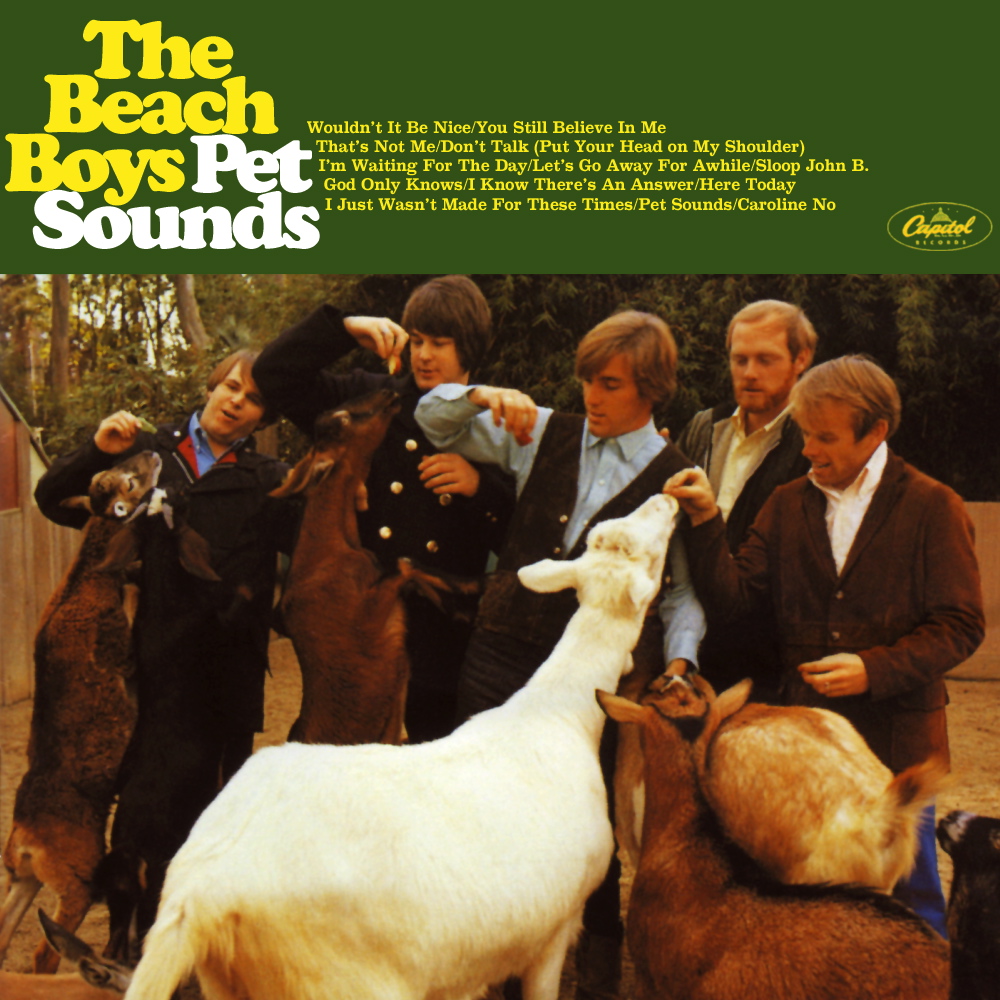
For the past few years I’ve wanted to write an epic, all-encompassing essay about The Beach Boys’ classic album PET SOUNDS.  I’ve sat down on at least two occasions and actually started, only to give up in disgust.  It seems like everything that could be said about has been said, by people far more knowledgable than myself, so why bother? Because I can’t stop listening and thinking about PET SOUNDS.  My adoration for this record has long since moved past obsession and I guess I want to try to make sense of how that happened.

Like all good art, PET SOUNDS is best described as a reflecting pool–esthetically beautiful and mirror-like in that we can see some of ourselves within it.  Sorting fact from legend in regards to it’s creation/recording is almost beyond impossible at this point.  It’s all too easy to say that PET SOUNDS is the singular work of one brilliant, tragic genius.  As an American, the notion that a complex, challenging piece of work springing from one rebellious individual is both romantic and affirming of our continental-myth of the “lone cowboy.”  On the other hand, the years have been kind to PET SOUNDS, much kinder than many of the people involved in creating it could have ever imagined, as a result many people have stepped up and claimed credit for an album they openly ridiculed during it’s inception.

Such a lovely album...such a terrible album cover.

PET SOUNDS is sort of the bastard son few people wanted to acknowledge at it’s birth–but later, as it matured and did good by itself–well, then many were practically falling over themselves to establish themselves as it’s parent. Does it matter that Al Jardine may or may not have insisted The Beach Boys include “Sloop John B” on the record? Or that he (or Carl) may have been solely responsible for it’s amazing arrangement?  At this stage in my life, my appreciation for PET SOUNDS, I don’t care about these matters.  All that is important for me is that PET SOUNDS exists, vacuum sealed from time and the bitter in-fighting of songwriters, musicians, arrangers, producers, studio technicians, and hangers-on.

Released in May of 1966, PET SOUNDS did not exist for me until the early 2000’s when I happened upon it in my Uncle’s CD collection.  I was in Nashville, trying figure out (among other things) who I was and what the hell I was doing.  I gave it a brief listen, made myself a copy, and promptly forgot all about it.  I’ve always been a “Beatles person.”  Growing up, The Beach Boys were that lame, striped-shirt-wearing novelty band that briefly styled themselves as “The American Beatles.”  People (mostly rock critics from Rolling Stone magazine) would, from time to time, blow my mind by placing PET SOUNDS near the top of many “Best Albums” lists, but otherwise–The Beach Boys had little credibility.  The only place I ever heard them was on the local golden-oldies radio station, placed strategically between Herman’s Hermits and Sam the Sham and the Pharaohs.

I still cannot recall exactly what compelled me to dust-off my copy of PET SOUNDS, but around 2008 I did.   Almost everything stupid (for lack of a better word) about The Beach Boys is missing from this record.  There are no dated, lame-ass novelty songs about surfing or hot-rodding.  No, PET SOUNDS is 13 songs about love, the confusion of youth, self-doubt, self-realization, loneliness, and also “Sloop John B” is tacked on (thanks Al/Carl).  The music is lush, full of complex and achingly beautiful arrangements.  Lyrically, the PET SOUNDS is almost the exact opposite of the music–the lyrics are so simple they sometimes strike me as slightly moronic.  I mean that in the best way possible, sort of like how people always remark how many startling truisms spring from the mouths of very young children.  The lyrical content of PET SOUNDS is simple but never basic, the observations aren’t plain and vanilla–but shockingly universal.

And that, I think, is why I’ve been obsessing about it these past few years (and why older people have been obsessing about it for decades).

The album-opener, “Wouldn’t It Be Nice” is probably the most recognized track, and a perfect example of what I’m talking about.  The song is about first-love, not silly puppy love, but actual honest-to-god love.  Anyone that’s ever felt that for the first time can completely understand the song, which is about the yearning to essentially always feel that feeling by being able to spend every minute of every hour with your lover.  This song encapsulates a very real feeling I think just about everyone has had.  And even though the sentiment may not be smart or realistic, that’s not the point–“Wouldn’t It Be Nice” is an explanation for every stupid teenager who’s ever run off an gotten married.  Still, an album filled with this sort of idealized romantic love wouldn’t be emotionally satisfying or realistic.  PET SOUNDS takes things further than 99% of pop albums (up to that time and since) with the very next song “You Still Believe In Me.”

“You Still Believe In Me.”opens with a confession that the song’s narrator has completely fucked up–and yet she still loves him.  Here, the wonder is not in the bliss of love but the endurance of love.  He tries, promises, and fails…and yet she still believes in him. “That’s Not Me” is another song about failure, this time the song’s narrator has decided to give up chasing foolish, impulse (saying “That’s not me”).  More than just a song of redemption, what impresses me the most about “That’s Not Me” is the self-realization that one’s dreams (and their pursuit) can not only be harmful but also maybe the opposite of what we really want. Stoned or sober that’s a mind-blowing realization.

This is what self-realization looks like, kids.

And then there is “God Only Knows.”  Not only is it hauntingly beautiful musically, but the it’s astonishingly rational while still being romantic at the same time.  Unlike a traditional pop-love song where the singer expounds about how he can’t live without the love of his life, “God Only Knows” acknowledges the fact that both he and the world would go on spinning without her, but he’s eternally grateful that he doesn’t have to be without her (because God only know where he’d be without her). I can live without you, but I don’t want to is infinitely more romantic than the foolish adolescent declaration of “I can’t live, if living is without you” (sorry Badfinger).  And you know, if PET SOUNDS was just about the complexities of love it would still be a damn good album–but it’s the introspective stuff that really pushes the album from “good” to “masterpiece.”

“I Know There’s An Answer” is about the search for the meaning of both life and self.  It’s about all those Nowhere Men sitting in their Nowhere Land, and how we ‘re all lost and adrift in lives.  There is no magic bullet answer that’s going to fix everything and make us happy, we have to save ourselves with our own answer.  Also, there’s no way of helping all the lonely people of the world without first helping yourself.

And much like “You Still Believe in Me” responds to “Wouldn’t It Be Nice,” the song “I Just Wasn’t Made For These Times” responds to “I Know There’s An Answer.”   “I Just Wasn’t Made For These Times” isn’t just my favorite song on PET SOUNDS, it’s also my all-time favorite Beach Boys song.  “I Know There’s An Answer” affirms that yes, there is an answer for all of us, but “I Just Wasn’t Made For These Times” is about what happens when we can’t find that answer.  It’s about failure and self-doubt.  It’s about feeling absolutely stuck–as an artist, lover, liver of life.  It’s about the profound sadness and dissatisfaction that stalk all of us throughout our lives.  And mostly, it’s about that feeling we all have at least once in our lives, that we don’t fit in or belong anywhere.  If you’re the least bit human you will find yourself relating to this song.  And while the song is, on the surface very sad, I find it one of the most comforting pieces of music ever written.  Not just in the misery-loves-company sort of way (though I suppose there is a great deal of that), no–“I Just Wasn’t Made For These Times” is like a music hug for me because it let’s me know that I’m not alone in feeling lost and sad.

Lastly, there is the bittersweetness of “Caroline No.”  It’s the final track on the album, and it’s all about the terrible way time strips us of the things we cherish the most.   It’s heartbreakingly sad and every time I go back to my hometown I’m reminded of Thomas Wolfe’s “You Can’t Go Home Again.”  Again, it’s the comforting universality of the song’s sentiment that gives the song it’s power.  Rather than struggle for a cheesy  redemptive silver-lining, the “Caroline No” does us the public service of letting the listener know that that’s just how life/the human condition is.  Rarely does commercial art, let alone pop music, deal with just weighty (and frankly unpleasant) topics without resorting to some kind of cliched “happy ending.”  What do unrealistic portrayals of life and love really give us, beyond a fleeting bit of pleasure?  They doom us to even greater sorrow, hoisted up by a Hollywood endings none of us are going to get.  The braver thing, I think, is to stare at both our souls and our sorrow right in the face.  So in that respect, PET SOUNDS is probably the only mirror I’ll ever need.

Tagged , , , , , , , , ,

Classic Album’s Revisited: THE KINKS ARE THE VILLAGE GREEN PRESERVATION SOCIETY

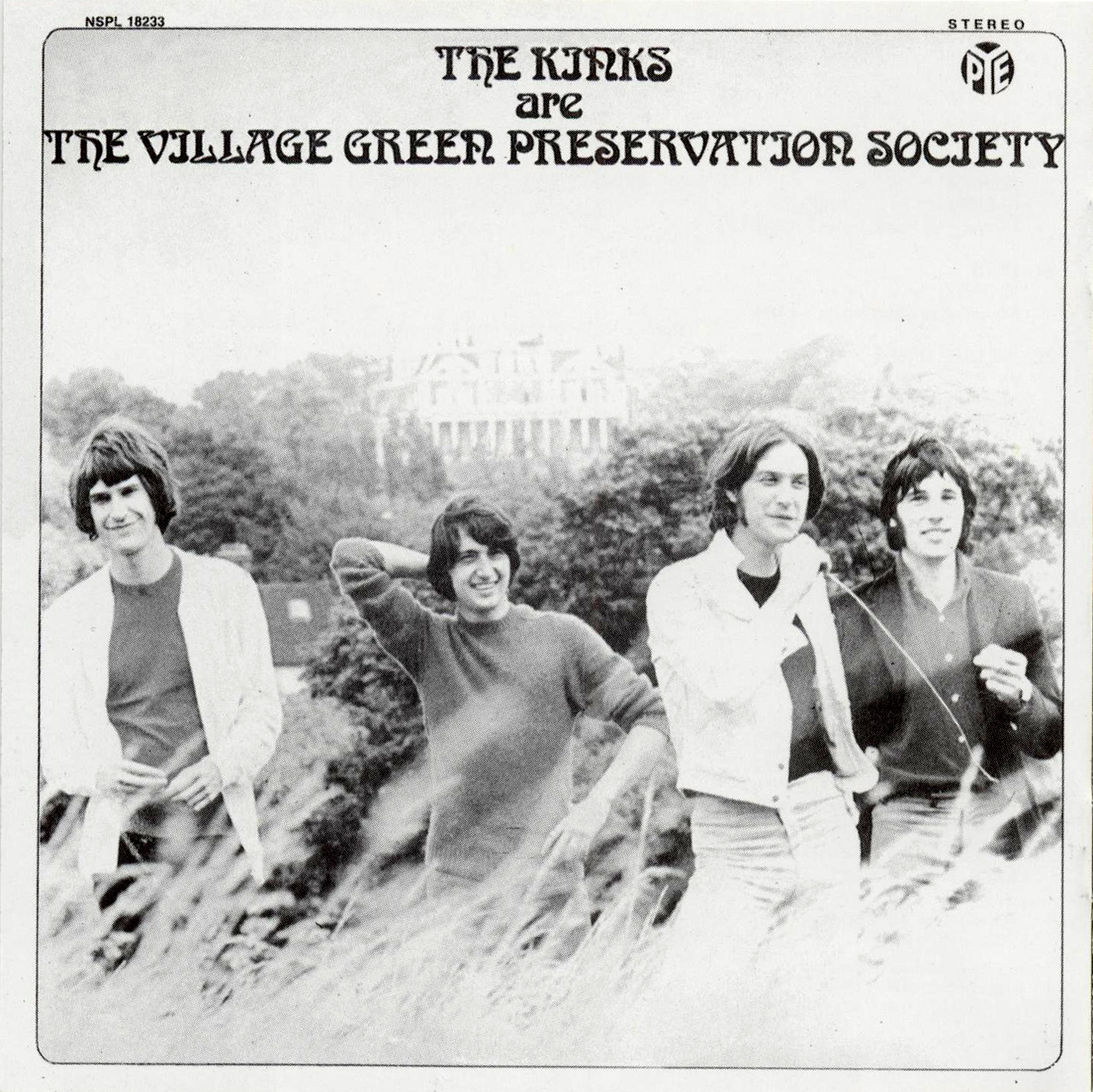
On  November 22, 1968 The Kinks released their sixth album THE KINKS ARE THE VILLAGE GREEN PRESERVATION SOCIETY (hence to be referred to as VILLAGE GREEN). Upon it’s release the album was branded a flop and the world moved on. But like a lot of great art, time has been kind to VILLAGE GREEN, and the album is now regarded as one of the band’s best efforts.

Not a bit of green on the sleeve, how odd.


VILLAGE GREEN is a very (very, very) English record. It’s also a concept album. These two factors probably contributed to it’s poor reception here in America. Singer-songwriter Ray Davies, who wrote all the songs on the album, celebrates the traditional English country-village (the “Village Green” which is brought up throughout the album), while at the same time lamenting and mourning it’s disappearance. It’s difficult to tell exactly how much of Davies bemoaning is genuine and how much is ironic. The album opens with the song, “The Village Green Preservation Society” which, though sung in a very sincere manner…if clearly meant to be tongue in cheek with it’s list of things the band (as the Preservation Society) wishes to protect: draft beer, china shops, custard pie, strawberry jam (and all different varieties), Sherlock Holmes (and Moriarty), and the whole damn “English speaking vernacular.” It’s all a bit extreme, including the assertion that this “society” is also the “skyscraper condemnation affiliate/God save Tudor houses, antique tables and billiards.”

And yet, even though the song is a bit ridiculous, to the extent that it seems to be a parody…in comes the chorus: “Preserving the old ways from being abused/Protecting the new ways for me and for you/What more can we do?” and I begin to wonder if perhaps Davies is only half poking fun. The answer can be found on the rest of the album, which is nearly 100% earnest in it’s assertion that the times are changing…and it kinda sucks.

Less about “green” spaces transforming into modern skyscrapers (though that’s in there too), VILLAGE GREEN is about how time and the change it brings effects one personal life. Ray Davies is a young-man beginning to realize he’s getting older. There are two themes of VILLAGE GREEN, both are very much intertwined. The first thing the album is about is time. The passage of time, the marking of time, the struggle against the change time brings, and finally the acceptance that one must grow older. The second theme of the album is photography, specifically as a reaction to time.

On a majority of the record the subject of photography/photos/taking pictures comes up. The question Davies seems to be asking throughout is: why do we take photographs? Is it because we love each other (like in “Picture Book” a song so pro-photograph it’s no wonder HP included it in a 2004 digital photography ad campaign) OR do we take photos for darker, more selfish reasons (like in the album closer “People Take Pictures of Each Other”)?

Davies and the rest of The Kinks seem to think it’s a little of both. “Picture Book” is a bouncy, glorious ode-of a song about looking back on one’s life via a big book of pictures. Though the chorus is a bit dark “pictures of each other/to prove we love each other,” the content of the photos described in the song are all seemingly random snapshots of our lives. It’s almost like photography as an extension of our memories. After all, if we don’t remember something, it’s like it never happened. And just like a picture of “a holiday in August/outside a bed and breakfast in sunny Southend,” our memories can be inexplicably random (why DO we remember the odd little things we remember?).

Again, not a bit of "green" on THE VILLAGE GREEN.

The darker side of photography, however, is found in “People Take Pictures of Each Other” (which actually seems like it should be the title of the more well known “Picture Book”). The song has a soft, French-like quality about it. Davies sings about how “People take pictures of the Summer/Just in case someone thought they had missed it/Just to proved that it really existed.” Which leads us to a world or mindset where, it’s not a question of “if you don’t remember it, it didn’t happen” but rather, to a place where “if you have no photographic proof of it…it didn’t happen.” I find that many people in my generation and beyond are obsessed with photos, so much so that many people (parents at a dance recital) agonize so much over the photos that they miss the actual moment. The song also touches on the albums other theme, of time when later one Davies sings: “You can’t picture love that you took from me/When we were young and the world was free/Pictures of things as they used to be/Don’t show me no more, please.” That’s a bold, and frankly powerful lyric…and really encapsulates the complexity of VILLAGE GREEN. The album goes from “Picture Book,” a love letter to photographs…and ends thirteen songs later with the exclamation “show me no more, please.”

That’s why this record is so fucking great. It’s this giant, complex mediation of life and death, disguised as a pop record.

“Do You Remember Walter?” has nothing to do with photos, but it’s a central track to the record. Whereas “The Village Green Preservation Society” is all about trying to hold onto the past, “Do You Remember Walter?” is a frighteningly realistic look at how that fight ALWAYS ends. The song is one man’s recollection of his old school chum, Walter. Walter and the song’s narrator were once young and idealistic–they were going to “fight the world and be free,” with the goal of saving their money and buying a ship to sail the world! Now he’s married and fat, in bed by 8:30. He’s not the cool guy that smoked and drank, and had a bunch of fun with his “mates.” Now he’s this empty shell of the free-spirited kid he once was. And, as the narrator laments, “Walter, you are just an echo of a world I knew so long ago/If you saw me now you wouldn’t even know my name.” This suggests to me, that the narrator–like Walter, lost that battle against time. There is a brief respite from the gloom, tucked away at the end of “Do You Remember Walter?” when Davies sings: “And if I talked about the old times you’d get bored and you ll have nothing more to say/Yes people often change, but memories of people can remain.” Which, in a way, reflects on the albums other theme of photography, in that like our memories, photos can preserve events AND people in the past forever. So Walter is gone, but never forgotten.

A bit of hope.

“Village Green” is a slower song, one that’s essentially a list of all thing country things that the narrator/Davies misses about pastoral Brittan. It’s a good song, notable for mentioning the titular green-space AND also referencing photographs: “American tourists flock to see the village green/They snap their photographs and say gawd darn it/Isn’t it a pretty scene?”

The Kinks ape The Yardbirds on “The Last of the Steam-Powered Trains” which shares many thematic similarities to “Do You Remember Walter?” It’s a bluesy-harmonica fueled stomp that finds Davies proclaiming that he is the last “of the good, old fashioned, steam-powered trains.” This of course, is used as a metaphor for Davies/the narrator’s staunch stand against the endless parade of time: “I’m the last of the good old renegades/All my friends are all middle class and grey/But I live in a museum, so I’m okay.” It’s about trains, but it’s also about being that last holdout against growing up and adult responsibilities.

But it’s not all heavy on VILLAGE GREEN. The album has fifteen tracks, and some have very little to do with any larger theme (except in the most abstract sense). Of these, I enjoy the vaudevillian “Sitting By the Riverside.” With it’s heavy use of keyboard (there’s a great freak-out moment mid-way the song, when the keyboard reaches this climax…this thunderous peak, then crashes and the vocals kick back in, it’s fucking great) and laid-back vocal harmonies, this song reminds me of the Beatles-throwback songs like “Your Mother Should Know” or “When I’m Sixty-Four,” in that it’s a rock band playing a song in a style their parents would have liked. I always find those kind of songs fascinating.

Another non-theme related song I find really interesting is “Big Sky.” “Big Sky” is a trippy, near-psychedelic song–that’s nearly spoken-word. Davies croons and wails about all the injustice/terrible things that the song’s “character” the sky (Big Sky) looks down upon…and shrugs. He shrugs because he’s, well because he’s just so gosh darn big, and our problems are just so small. Is Big Sky God? Does God, like Big Sky, see our problems and find him/her/itself too powerful or mighty to help? Or is Davies being a bit sarcastic, is Big Sky not really overwhelmed but rather complacent?

“People lift up their hands and they look up to the big sky/But big sky is too big to sympathize/Big Sky’s too occupied/Though he would like to try/And he feels bad inside/Big sky’s too big to cry.”

What is Big Sky “too occupied” doing? Is he too busy staring down at our suffering to do anything about it? Maybe God’s hypnotized in such a manner, maybe that’s why we have war and disease and suffering. Then again, isn’t that what we all do? Don’t we as people look at other suffering and throw our hands up and say “I’m too busy to help!” What are we too busy doing? If The Kink’s “Big Sky” is God, then we were certainly made in his/her/it’s image.

From contemplating such large, theological questions, The Kinks switch over to the “Star-fucker” phenomenon on the song “Starstruck.” Which of course is about a girl who runs around, going nuts because she’s starstruck. Other album oddities include a song about fat cat (“Phenomenal Cat”), and an Orwellian-ode to Animal control of the world (“Animal Farm”). All three of these tracks make fantastic use of the mellotron–which allowed the band to simulate woodwind instruments (though they sounded pretty real to me).

I’ve probably over-thought this record. I know I’m misrepresenting it–it’s not a dodgy, stuffy old record with a lot of things to “say.” VILLAGE GREEN is just a rich, detailed, thought-provoking piece of art that, like a good painting or film–can stimulate the mind and, if you chose…give you something to think about.

Or you can hum along with it. It’s full of wonderful, beautiful hooks. VILLAGE GREEN is a very literate, yet very lively rock record. And we all know how few of THOSE are being made today. What do I have to do, put it in your hands? Go. Get it. Listen.

Tagged , , , , , , , ,