Defending Axl Rose
an abnormal music blog
Classic Albums Revisited: MR. TAMBOURINE MAN
I feel bad, but I’m afraid there is no way to discuss The Byrds–especially early Byrds–without talking about Bob Dylan. I just don’t think it can be done. So, before I get into the Dylan-ness of this record, let me talk about The Byrds themselves as a band. The Byrds formed in 1964 in sunny California. At that time the British Invasion was in full swing. What made The Byrds so interesting is that they combined the British rock sound with American folk music. In doing so, they pretty much paved the way for what we consider modern folk music–Joni Mitchell, Gordon Lightfoot, and Neil Young (along with pretty much all the singer-songwriter types from the 1970s “folk boom”) owe The Byrds a huge debt. At the same time, the band was pretty influential on the rock scene as well, without The Byrds there would be no Tom Petty.

Byrds with a fisheye.
What’s so interesting about The Byrd (among other things) were all the various changes they made throughout their short existence (going from the folk-rock, electric Dylan covers to “Eight Miles High” THE first psychedelic rock song) and the impact those changes had on a borad spectrum of artists.
The secret to their success was their harmonies (of course) and Bob Dylan. The band’s first commercial hit was a cover of Dylan’s “Mr. Tambourine Man.” Dylan is a super-gifted songwriter, but unfortunately sounds exactly like a Muppet. This “Muppet-sound” tends to turn off a lot of people and doesn’t always best serve the song. I’m a huge Dylan fan, don’t get me wrong, I love his croak but I know that I am in the minority. Anyway, beyond having a better, more commercially palatable vocal arrangement, The Byrds also had a knack for interpreting Dylan’s songs, NOT just covering them. I believe there is a difference. A “cover” is just that, one artist playing another’s song–usually note-for-note. The Byrds didn’t do this; instead they took a great fucking song, “Mr. Tambourine Man” and made it electric (with shiny, bouncy electric tones). They added layers of harmony. Listen to Dylan’s version and The Byrds, one right after the other…and it’s seems like barely the same song. Both are good (some will always prefer the author’s version because it’s the most “pure” or whatever, me I’ve out-grown such pretension) and both have the same level of merit–a sure sign that you’ve got a good, artistically executed interpretation on your hands.
With the success of “Mr. Tambourine Man” came an album–MR. TAMBOURINE MAN, this seems to me to be more of a “if-it-ain’t-broke-don’t-fix-it” mentality cooked up by some record label suits but I could be wrong. Besides the title track, the band also covers Dylan’s “Spanish Harlem Incident,” “All I Really Want To Do,” and “Chimes of Freedom.” There are other notable, non-Dylan covers on MR. TAMBOURINE MAN include “We’ll Meet Again” (remember that song? It was used ironically at the end of the Peter Seller’s comedy/farce DR. STRANGELOVE) and “The Bells of Rhymney.”
But it’s the Dylan covers that really wow me, they’re all brilliant. I especially love “All I Really Want To Do,” a track the band injects with a much needed dose of levity. Dylan’s version is so damn bare-bones, and Dylan’s yodel-wail is a little bit…much (almost to the point of self-parody). The Byrds give a more energetic version. Dylan’s midnight-dark satire of a failing marriage goes down much smoother with The Byrds (hell, it almost sounds like a love song).
What surprised me most about MR. TAMBOURINE MAN was how strong the band’s original compositions are. Gene Clark’s “I’ll Feel A Whole Lot Better” is my personal favorite track–of the whole record (Dylan covers included). The band’s songwriting, while still in it’s early stages, was strong enough to compete with such a legendary song-smith. “You Won’t Have To Cry” and “It’s No Use” are likewise able to hold their own with Dylan’s songs. Though MR. TAMBOURINE MAN has only hints of the work the band’s later (some might argue greater) work, I find this record to be thoroughly enjoyable and uncluttered with the excess of the later, “trippier” recordings. Unlike a lot of bands from this period, work The Byrds did on this album stands the test of time.
METAL MONDAY: An Epic Review of “Dopesmoker” the Song the Label Didn’t Want You to Hear!
It’s been a long time since I did a METAL MONDAY post, and for that I am truly sorry. In order to serve my penance for neglecting rock’s more aggressive-cousin, I embarked on an gargantuan journey that only the most die-hard music writers would even dream of undertaking**. I was reading the latest issue of SPIN magazine (don’t judge, I bought a subscription from a woman at work who’s granddaughter was doing a magazine fundraiser) when I saw a small article about an obscure metal reissue that came out this month–DOPESMOKER by Northern California’s Sleep. Sleep were active during the 1990’s and existed in that grey area between doom-metal and stoner-hard rock. I’d never heard of them, but what caught my eye was the fact that the album consisted of one single, hour-long track. The album was recorded in 1996 but the band’s label, London Records, was appalled by the finished product. And in a way, I don’t blame them–what the hell do you do with an hour-long song? The band refused to let the song, “Dopesmoker” be cut-up into slightly smaller chunks and instead insisted it be released as one mega-track. This fight delayed the album’s release until 2003.

“Caravan migrates through deep sandscape
Lungsmen unearth the creed of Hasheeshian
Procession of the Weed-Priests to cross the sands”
Thanks to the Internet, and a hearty fan-base, DOPESMOKER was reissued as the band intended: uncut. I read a few accounts of the album’s production, and apparently the song had to be broken up a few session due to the limitations of recording technology at the time (a reel of studio tape could only hold 22 minutes or so). With nothing but guilt over neglecting METAL MONDAY and extreme curiosity, I sat down and listened to the whole thing (below are my impressions/blow-by-blow of the song).
Stoners are usually annoying, ineffectual, or somewhere in between. I fully expected “Dopesmoker” to be pretty much a boring wank-session, I was pleasantly surprised to find that it actually pretty damn good. The song is built upon a foundation of droning guitar and lyrics revolving around an ancient, yet spacey, marijuana cult. The lyrics, like the song, are dramatically elongated, like a stoner taking a loooong hit off a bong. Musically, Sleep seem to be like a super-wasted/super-slow Black Sabbath. In fact, the entire time I was listening to “Dopesmoker” I was reminded of “Sweet Leaf.” I also couldn’t get the image of a stretched piece of taffy out of my mind–I think that’s a pretty good comparison for this record/song: Black Sabbath, if Sabbath was a piece of taffy, stretched to it’s near-breaking point.

Vigorous Sleep-ers.
The song has three guitar solos that aren’t overly-long or stupid, another thing that surprised me about DOPESMOKER. Metal guitar solos have a history of being supremely over-the-top to the point of being ridiculous, and in a song that’s over an hour long it would make sense to have really drawn-out solos to pad time. But Sleep seem to side-step every single cliche I thought of when I initially read about this album/song. The lyrics are pretty stupid. I mean, really stupid. This isn’t stoner-philosophy, this is crazy weed-mysticism to the 1,000,000th power. They’re pretty damn funny and frankly work for me. Had this song been long AND full of bullshit seriousness I’d have to label Sleep as pretentious.
“Dopesmoker” begins and ends with the lyrics “Drop out of life with bong in hand/Follow the smoke toward the riff-filled land.” That Sleep not only created this riff-filled land, but let all of us mere mortals visit it is a good thing. I won’t lie and say that Sleep’s magnum opus is for everyone, but for those brave souls willing to enter their ancient caravan of cannabis…adventure awaits.
What follows is a timeline of my thoughts written as I listened to “Dopesmoker” for the first time:
00:01: A few single notes begin.
01:30: And there was much droning.
02:41: Drums begin.
05:37: The droning has become an undulating current of a single riff, repeated.
07:30: Lotta cymbal action, the riff has changed
08:01: Drums vanish, then return.
08:27: Vocals appear, shout-y.
12:42: We return to a more complicated version of the main riff.
14:24-ish: Guitar SOLO!!! It’s pretty damn sweet.
16:31: Guitar Solo ends.
16:40: Vocals commence again with “Proceeds the Weedian – Nazareth.” I don’t know what any of this means…
21:30-ish: Main riff and drums fall off, single note riff (different from the beginning) takes over. I feel as if the first phase of the song might be over.
22:53: Smashing drum riff and vocals return. The phrase “Holy Mountain Zion” is sung…all three words are sung in an elongated-howl.
26:50-ish: Huston, we have “Weed-priests.”
31:15: The half-way point, nothing auspicious happens to celebrate this occasion, our “Stoner caravan” continues marching forward.
38:55: Second guitar solo begins.
40:00: This is a classy-ass solo, I’m digging it.
41:28: Solo ends.
41:45-ish: Whole mess fades out with the exception of a single guitar.
42:00-ish: drums appear distantly, in the background, like a distant heartbeat.
43:06: If I didn’t know any better, I’d think the song was winding down/about to end. There is still 20+ minutes to go.
43:27: The song rewakens! Riffage/thunder-fuck drums return.
48:00: “Marijuanaut escapes earth to cultivate.” Right on.
50:33: Third guitar solo begins.
51:53: Guitar solo ends.
52:20: I am on the edge of my seat, I cannot wait to see how they end this song. If this thing just fades out I am going to lose it…
54:30-ish: “Burnt offering redeems – completes smoked deliverance.”
60:00: Woah, we’ve reached the hour mark. T-minus three minutes and 36 seconds remaining.
62:21: Looks like we’re gonna drone-riff our way out.
63:15: Last notes are held and then allowed to fade. Not the bombastic ending I was hoping for, but it wasn’t a cop-out.

The End.
**Not really
From the “Nobody-Could-Have-Seen-This-Coming-File”: VAH HALEN POSTPONE 31 SHOWS
Well imagine that, Van Halen are having a bit of turmoil! Rolling Stone reported late this week that the classic rockers are “postponing” 31 shows. No one would say why, but a “source” close to the band said that “they hate each other” and that they can’t stop fighting. Apparently they can’t even stop fighting to count all that money. The band is currently still performing, but band reps let everyone know that after their June 26th show in New Orleans, the band isn’t going to play anymore shows. But will the fans who bought tickets get to see the band? Or see their money back? No one is talking in either the Van Halen-camp or the Live Natio-camp (Live Nation being the evil Corporate overlords).

Quick! Someone explain to Van Halen how capitalism works: You have a product, we pay for it…then you give it to us.
I, for one, am full of regret that I missed Van Halen when they recently rolled through St. Louis (I was at another concert) because I only heard awesome things. Still, are we really surprised that Van Halen aren’t getting along and might back out of a mega-comeback tour? The band is a potent concoction of “we hate each other.” Podcaster Adam Carolla likes to ask Rolling Stone writer David Wild about the untold millions dunder-headed rockers leave “on the table” just because they can’t sack-up and get along. I have no idea how much money Van Halen stands to lose if they don’t play these 31 remaining shows, but I’m sure it’s a phenomenal amount. The Rolling Stone article quotes a promoter as saying that the shows have been selling really well, so the notion that the band is pulling out of the concerts because they aren’t selling enough tickets isn’t the case.
Anyway, if you have tickets for any of the following shows, you might want to start making other plans:
July 7: Uncasville, Ct., Mohegan Sun Arena
July 9: Hampton, Va., Hampton Coliseum
July 11: Philadelphia, Pa., Wells Fargo Center
July 13: East Rutherford, N.J., Izod Center
July 15: Baltimore, Md., 1st Mariner Arena
July 17: Rochester N.Y., Blue Cross Arena
July 19: Detroit, Mich., Joe Louis Arena
July 21: London, Ontario, John Labatt Centre
July 24: Toledo, Ohio, Huntington Center
July 26: Grand Rapids, Mich., Van Andel Arena
July 28: Cleveland, Ohio, Quicken Loans Arena
July 31: Fort Wayne, Ind., Allen County Memorial Coliseum
August 2: Columbus, Ohio, Schottenstein Center
August 4: Knoxville, Tenn., Thompson-Boiling Arena
August 6: Memphis, Tenn., FedEx Forum
August 8: Birmingham, Ala., BJCC Arena
August 10: Greenville, S.C., BI-LO Center
August 12: Cincinnati, Ohio, US Bank Arena
August 21: Spokane, Wash., Spokane Arena
August 23: Portland, Ore., Rose Garden
August 25: Sacramento, Calif.,Power Balance Pavilion
August 28: Fresno, Calif., Save Mart Center
August 30: Reno, Nev., Reno Events Center
September 4: Salt Lake City, Utah — EnergySolutions Arena
September 8: Albuquerque, N.M., Tingley Coliseum
September 11: El Paso, Texas, Don Haskins Center
September 13: Austin, Texas, Frank Erwin Center
September 15: Oklahoma City, Okla., Chesapeake Energy Arena
September 17: Wichita, Kan. – Intrust Bank Arena (WFT, I’m from that part of the world and I’ve never heard of this venue)
September 21: Moline, Ill., Iwireless Center
September 25: Milwaukee, Wis., Bradley Center
* * * * * *
UPDATE: I forgot to bash Wolfgang Van Halen in this post, for that I truly apologize. In order to correct this oversight, let me just say that this is most likely all Wolfgang’s fault. The band postponed these shows because Wolfgang is fat.
George Harrison & “My Sweet Lord”
In many ways, I can’t think of two people more apart than John Lennon and George Harrison. During their brief time together as members of The Beatles, it was pretty obvious who the genius songwriter was. Lennon’s work and tragic murder have (ironically) deified him as rock god. George was always known as “the quiet one.” And though he did start to come out of his shell towards the end of The Beatles life-span, it wasn’t until he went it alone as a solo artist that George Harrison became, in my opinion, John Lennon’s equal. Growing up, the first solo-Beatle music I listen to was Paul McCartney and then John Lennon’s solo work. I never considered Ringo or George’s solo output until I heard a super-catchy, awesome song on the radio one summer afternoon. It sounded like a lost Beatles track, something off of ABBEY ROAD. I was able to jot down most of the chorus on a scrap of paper and the next time I got online (dial-up) I was able to do a search. I found out the song I’d heard was “What Is Life?” by George Harrison. The song comes from George’s landmark solo (double) album ALL THINGS MUST PASS. That’s a fitting title for an album recorded after the end of one of pop music’s greatest bands.

ALL THINGS MUST PASS is an achingly beautiful record, through and through. Eric Clapton, Billy “The Fifth Beatle” Preston, and Ringo all played a part in it’s recording–but ALL THINGS MUST PASS is George’s record. Whereas Paul’s solo music is pretty bubblegum and John’s solo stuff was angry and political (see “Woman is the Nigger of the World”), George Harrison’s solo work is very down-to-earth and deeply personal. Somewhere between Paul’s commercial cash grab and Lennon’s brash antiestablishmentarianism–lies the music of George Harrison.
The crown jewel of ALL THINGS MUST PASS is a song called “My Sweet Lord.” This song is a stark contrast to the work of Paul McCartney & Wings. And it’s 1,000 miles away from John Lennon’s classic “Imagine.” A deeply spiritual (but not religious) man, Harrison’s song is a devotional ode to his creator. As an apathetic agnostic, I find myself filled to the brim with envy every time I hear it, the sentiment is so pure and simple. In fact, the song reminds me a lot of the numerous Medieval poems I had to read in my British Literature classes back in my college days. Listening to “My Sweet Lord” and then “Imagine” is pretty crazy/disconcerting. How were these two men from the same planet, let alone in the same band? I don’t think Lennon or Harrison were “lying” in either case, I think that they were just able to put their differences aside and be friends despite their wildly different world views.
That said, if I had to live in the world of one of those songs, I’d pick “My Sweet Lord” everyday (and twice on Sunday, pun intended). The song was instantly popular, despite the fact that George didn’t initially have it released as a single. It wasn’t until radio stations played the crap out of it that public demand led to the song being issued as single in 1971. “My Sweet Lord” was also the first single by an ex-Beatle to reach #1. A remarkable feat, one that would come at a heavy price–the increased scrutiny lead to lawsuit. The song “My Sweet Lord” is fairly similar to a song written by Ronnie Mack called “He’s So Fine.” Yes, George Harrison may have (subconsciously) used a song made popular by the girl-group The Chiffon’s to write one of the greatest love-letters to God. The court battle (Bright Tunes Music v. Harrisongs Music) was lengthy and George lost, but in the end we all won because “My Sweet Lord” is a beautiful song and the world is a better place that it exists.
Stripped down acoustic guitar, harmonized slide guitars, George’s distinctive voice, and the sublime lyrical marriage of eastern and western religious chants. It’s a perfect song, through and through.
Highly-Unscientific Rock Poll: All-Time Best Song of Summer
Sometimes there are questions too big for one man. Sometimes, in the search for ultimate truth, we must seek the guidance of others. And then there are times when one wants to increase traffic to one’s blog by actively seeking participation of one’s small readership by stoking the fires of eternal debate…
Yes friends, it’s time to review the lastest statistical disaster I like to call my HIGHLY-UNSCIENTIFIC ROCK POLL! With the temperatures rising and the days lasting longer, I found myself in a summer mood. I have a lot of fond memories of sitting by an inflatable kiddie pool listening to the radio. I also spent an inordinate amount of time driving around the suburbs listening to an assortment of shitty pop stations. Anyway, summer means many things to many people, which meant choosing an all-time best song of summer wasn’t going to be easy–luckily I had some help this week.

9, 8, 7 and 6 (no votes) “Let’s Go Surfin” and “California Girls” by The Beach Boys, “Summertimes Blues” by Eddie Cochran, “The Boys of Summer” by Don Henley, and “Summer Mood” by Best Coast: So I guess I should start off by saying that this poll is full of meddling. Even though about the same number of people participated in the poll as usual, meddling was up 300% from my last two rock polls. Initially I only had one Beach Boys song on the list, but one of my relatives on Facebook (where these scientific polls are conducted) asked me to add “Let’s Go Surfin,” which is fine but after I added it–she didn’t vote. So technically “Let’s Go Surfin” should have one vote, but I’m a stickler for the rules and just commenting on a poll does not equal an actual vote. I’m a Beach Boys fan, as cheesy as 99.999% of their songs are–you have to give them one thing: they own the summer. They have so many songs about the beach, summer, waves, surfing, riding around in cars, etc. that to exclude them from your summer music mix would be a crime. “Summer Mood” by Best Coast was my attempt to add something a bit newer (less classic rock-ish) to the poll, though I can see why they got no votes. I absolutely love Don Henley’s “The Boys of Summer.” That song really takes me back to high school and all the things I should have done, could have done…it’s a very bittersweet song and whenever I hear it I think about those high school summers. I’m a bit surprised it didn’t get a vote (I couldn’t vote for it because it makes me a bit sniffly).
“Summertime Blues” by Eddie Cochran, are you fucking kidding me? No votes? Clearly this poll is unscientific because we all know that song kicks-ass–there ain’t no cure for the summertime blues!!!!
3. “In the Summertime” by Mungo Jerry: Alright, more meddling, but this was meddling of the welcomed variety. One of my poll-takers added Mungo Jerry’s laid-back classic to the list, how I forgot this tune I’ll never know. I heard it again on the radio and it pretty much sums up the summer experience. I don’t know a thing about Mungo Jerry, and I bet you don’t either, but we’ve all heard the song. If I could have had two votes I definitely would have voted for this song. I also love how creepy/fucked up it is towards women. It’s such a happy-song and then bam! The singer give you advice about how to treat the daughter’s of rich and poor men (“if her daddies rich, take her out for a meal/if her daddies poor, then do what you feel”). I always like a little creepy in my summer.
2. “It’s Raining Men” by The Weather Girls: Sigh, this was more meddling on the part of my poll-takers. I guess this is what I get for allowing people to add their own options. DEMOCRACY: IT JUST DOESN’T WORK.
1. TIE: “School’s Out” by Alice Cooper and “Summer in the City” by The Lovin’ Spoonful: I voted for “Summer in the City” because it’s catchy and a little scary sounding. That keyboard riff is iconic, you hear it and you instantly know what song your hearing. Mungo Jerry’s song perfectly captures the easy-going nature of the country in summer and The Lovin’ Spoonful do the same thing for the city. Except the city is not easy-going. The song rhymes “city” with “pity” so you know dark shit is going on. Whenever I hear this song I think about that dirty mixture of smog and sweat.
Alice Cooper’s “School’s Out” is a fantastic choice for #1 as well. We’ve all been there–counting down the days until school was out for the summer. Remember cleaning out your locker? I used to gleefully throw everything away. School is out for the SUMMER! It’s been a few years since I was “out for summer” so this song has lost a little of it’s appeal, which is kind of sad now that I think about it. Like “Summer in the City,” “School’s Out” has a dark edge to it as well (what with all the talk about school being blown up and the chuggy-guitar riff). When I think of summer, I don’t think of “dark” or “gritty” so why did these songs end up getting the most votes? I suppose it’s the highly-unscientific nature of the poll, but I also think that as a species we’re attracted to the macabre…even in the middle of summer.
Best Coast & Wavves: An Indie Rock Love Story
A few weekends ago I saw Tony Scott’s TRUE ROMANCE for the first time (not sure why it took me so long to finally see it). Have you seen this movie? It’s pretty good, if you haven’t you need to check it out. Anyway, in a nutshell it’s about these two completely looney/borderline-psychotic people who fall in love…and into a whole world of trouble. It reminded me of Bethany Cosentino and Nathan Williams. These two kids just belong together, even though it would probably better for them both if they weren’t a couple… I can’t believe how invested I am in their romance. Anyway, Bethany is a band called Best Coast and Nathan fronts a punk-pop-noise band called Wavves. Both hail from California and are full of a kind of youthful vigor and passion that makes me both incredibly happy and sad at the same time.

She and him together (with a photographer).
Let’s go back to 2010. I can’t remember where exactly I was when I first heard Wavves, but somehow I heard them and they blew me away. Wavves is everything I love about rock and punk all rolled up into with a generous sprinkling of killer stoner-riffs and shit-tons of attitude. And not to draw too many comparisons to another famous California band (i.e. The Beach Boys), the lead singer the leader of Wavves (Nathan Williams) wrote about the beach and the ocean–even though he doesn’t swim. I guess that appeals to me because I don’t know how to swim either. The mysticism/idea of the American beach-scene is so appealing to me, even though I’d never take my shirt off in public. Because it’s not about taking your shirt off or swimming. Hell, it’s not even about surfing. It’s about the freedom; the foot-loose-and-fancy-free attitude. It’s also about the notion that all of life can be distilled into a “way of life”, a way of life revolving around beach fires and surfing–that shit appeals to me.
It wasn’t soo after I started listening to Wavves excellent album KING OF THE BEACH that I found out the mysterious Nathan Williams was head-over-heels in love with a cool stoner chick named Bethany Cosentino–who it just so happened, fronted a band of her own called Best Coast. Best Coast and Wavves, could their names be a more perfect match? And their music compliments each other as well. Where he is sour, she is sweet. It’s a bittersweetness, but a sweetness nonetheless. I got her band’s album BEST COAST and found myself liking it just as much as KING OF THE BEACH (though in a different way) . Listening to both albums and knowing that the two are connected is like watching a film in 3-D, it’s not necessary to enjoy the proceedings but it does add an extra dimension to proceedings, and yes…it does make you feel like you are “there.”
Their unwieldy, moody young love is laid bare in both of their records, almost to an embarrassing extent. That these two people, a stoner-skater boi and a cool-ass artist chick, would need each other so much is as startling as it is pedestrian. In a way they’re like an indie version of Romeo and Juliet. Whereas his music is brash and defiant, her’s is wistful and seductive, but even on his KING OF THE BEACH record, there are moments of genuine affection I can’t help assume is directed at Bethany. By themselves Bethany and Nathan are good, but with the help of their love, what they create is amazing. His KING OF THE BEACH album and her BEST COAST album are perfect bookend/yin-and-yangs. They complement each other in ways that only a man and woman in love could. But they are young, famous, and artistic–and their love, while perfect in it’s imperfection, can only last so long. I hope I’m wrong. In fact, even though I’m not religious, I pray that I’m wrong. Having them break-up would be more devastating than if my own parents broke up.
The BEST COAST album is nothing but a giant love letter to Nathan: he doesn’t love her as much as she loves him, she needs him, but he just wants to be friends. He’s a typical young jerk, not willing to give himself completely to her. It’s just how he is. The Wavves album, KING OF THE BEACH is playful, and at times angry and defiant, he’s just having fun and getting stoned…on her weed we find out from listening to the Best Coast album(!). The Wavves album is balls-to-the-walls FUN, whereas the Best Coast album is tortured and a little sad (why won’t he just love her the way she loves him?). In a way, it’s a bit like inhabiting the bodies of two people witnessing the same car accident–both are seeing the same thing but a few key details seem to be fundamentally different based on their individual biases.
there are moments on the Wavves album where we see that Nathan can’t espace Bethany and his feelings for her (like on “Green Eyes”). Watching them fall in love–or rather listening to them–is magical and akin to seeing a younger brother or sister experience love for the first time. I don’t want either of them to get hurt because I like them both, but I know that’s not possible. And yet I wouldn’t have it any other way. Because that’s just what young people do–they fall in love and get hurt. It’ll make them better people in the end, and probably give us at least three or four awesome Wavves/Best Coast albums worth of material.

The third person of this love triangle–SNACKS the CAT!!!
Best Coast has a new album coming out on Tuesday, and I’m a little worried. The first Best Coast record, BEST COAST, is full of beautifully tortured unrequited love songs…all about Nathan. Now that the two rockers are living in rock-bliss, what kind of record will we get? I mean, I want these kids to be happy, but I also want their records to be badass…and happiness and badass rock are not always the best of friends. But I’m going to reserver judgement until I’ve heard the full record. Perhaps the bliss of young love will surprise me and provide fertile rock material (but I doubt it). It’s a bit of a double-edged sword: I want them to be happy but at the same time I want awesome records that only emotional discontent will provide.
Wavves put out an excellent EP last year (LIFE SUX) but a forthcoming album has me worried. What will Nathan do now that he’s happy? Why does an artist have to be unsatisfied to produce worthwhile art? I don’t make the rules kids, I just live by them. Either way, these two bands have done more than just mythologize the great state of California, they’ve provided me a window back into the tortured world of young love. If you have a heart and love rock and want to relive young (stupid, incredibly destructive) love, then I strongly urge you to check out the stoner-rock-punk shenanigans of Waaves and the echo-y, lovelorn sounds of Best Coast.
MAD MEN’s $250,000 Beatles Sample
So this just ties into the post I did yesterday about Girl Talk’s 100%-sample-album FEED THE ANIMALS: The New York Times is reporting that the cable channel AMC paid $250,000 to air a portion of “Tomorrow Never Knows” on last Sunday’s episode of MAD MEN. It was a great moment, one that perfectly encapsulates how the times are changing and how those times are passing a certain character (no spoilers). Though $250,000 sounds like a lot of money to most people (myself included) I actually think that it’s a pretty good deal for AMC considering The Beatles are one of the most protective bands when it comes to their catalogue. You see, the show didn’t just air the song performed by another singer/band–the MAD MEN episode played the ACTUAL song performed by the actual BEATLES. This is a pretty rare event, as noted by the Times article which states the song “Tomorrow Never Knows” has never been performed on television.
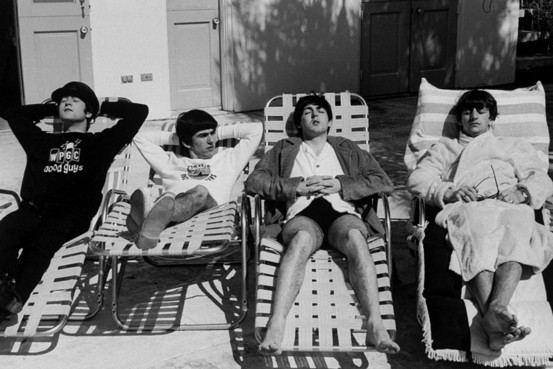
With all those royalties, The Beatles have it made in the shade…
It also turns out that this marks the first instance where The Beatles have allowed one of their songs to be featured on a television series (with the only exception being the ABC animated Beatles cartoon show that ran in the 1960’s, of course). When I saw the episode on Sunday I was pretty excited that the song was used, being the huge Beatlemaniac that I am, but I didn’t stop and consider just how pricey such a cameo by the band might be. I feel sorta bad for MAD MEN’s creator/writer Matthew Weiner, after all when doing a show set in the 1960’s it’s pretty much impossible to avoid the Fab Four. It was only a matter of time before AMC had to pony up the big dough to feature the band.
I wonder how pissed Keith Richards/Mick Jagger are right now?
GIRL TALK & The Art of Sampling
So lately I’ve been listening to Girl Talk’s 2008 album FEED THE ANIMALS. I know, I’m a little late to the party, but I’ve been busy.
For those unfamiliar, Girl Talk is really one a musician named musician Gregg Gillis who uses unauthorized samples. Of course, that’s putting it lightly–Girl Talk’s music is damn-near 100% samples. Now, I love a good mash-up as much as the next guy. The thing is…there aren’t very many good mash-ups. A mash-up seems like a really easy thing to create, song 1 + song 2 and you’re done. But it’s more complicated than that, it takes a lot of time and effort to create a mash-up. And it takes probably ten times longer than that just to come up with good/interesting song pairings. So understand, I’m not coming from a place where I think Girl Talk creating entire albums of mash-ups is easy or simple. Gillis has talent, that much is apparent when you listen to FEED THE ANIMALS. The songs swirls together, blending so seamlessly you literally need a scoresheet to keep track of what exactly you’re hearing. Luckily there are people who have made such a scoresheet.

Why does Girl Talk hate that man’s lawn?
So if it sounds awesome and it’s not super-simple/requires some consideration what’s my problem? Why can’t I just let go and enjoy?
I don’t think it’s the fact that FEED THE ANIMALS is probably the most illegal record I’ve ever heard. True, I think it sucks that he didn’t pay the respective copyright holders a dime in order to sample their music, I don’t really blame him. I mean, for one thing, the number of samples is staggering. A glance at one of the charts that detail the samples created by Girl Talk fans reveal a massive amount of samples–some of which are only a few notes others complete hooks or riffs. But let’s pretend the guy had an unlimited supply of money and had asked for permission–many of the artists sampled on FEED THE ANIMALS probably would have said no. Do you think Ace of Base (or their copyright holders) want to be associated with DJ Assault’s song “Ass and Tities”? I don’t think so. FEED THE ANIMALS features samples from several artists that don’t want to play in the digital age, like AC/DC, who don’t distribute their music in very many digital venues outside of iTunes (and they do that begrudgingly). It also features Michael Jackson. Do you think the Michael Jackson estate would let someone mash-up and mangle his music . Rappers sample all the time, but what Girl Talk does is sampling taken to the next level. Artists that might not be unfavorable to a more traditional sampling (like Jimmy Page appearing on Puff Daddy’s “Come With Me”) might not like Girl Talk’s 2% usage of a song. There’s glory in having your stomping rock riff sampled or you chorus used, there is no glory in a few fleeting seconds.
I know that music is a business and that for the right price anyone will sell anything, but I can’t see FEED THE ANIMALS existing as a legal product. But is it the illegality that’s holding me back from fully enjoying FEED THE ANIMALS? I don’t think so. I think ultimately Girl Talk is the harbinger of terrible things. I recognize that what Gillis does is pretty awesome, but what he’s done is basically stand on the shoulders of giants. As good as “Give Me A Beat” is, it’s nowhere near as creative as Tom Petty’s “American Girl” or Carole King’s “It’s Too Late,” hell it’s not even as creative as Brittany Spear’s “Gimme More” (all three of which are sampled in “Give Me A Beat”). Taking something from nothing is infinitely greater than building on an existing foundation (especially if that foundation includes Brittany Spears). When a rapper samples he’s still written his verses if he hasn’t also created his beats. What does Girl Talk create? It creates a julienne-cut jukebox.
FEED THE ANIMALS is a work of art and Gillis’ efforts is to be admired, but I can’t help but worry about the next step. I can’t help but worry about a generation of kids that grow up listening to albums like FEED THE ANIMALS. Will they bother to learn how to play instruments? Will they bother with songwriting? Or will they skip over a few dozen steps and create mash-ups of songs created by samples of other mash-ups. I feel like Girl Talk is an evolutionary dead-end. It’s like a platypus, unique and interesting…so long as we still have other animals.
Spotify, A User’s Review
A few months ago, my best friend told me to about a new online music service called Spotify. Now I know it’s not the vogue thing to do anymore, but I still like to pay for music from time to time. Sure, don’t get me wrong, I have stolen music in the past but if I really like something I always make a purchase, especially if it’s a new/up-and-coming band. I’ve been intrigued and tempted by online music services in the past, but thus far I haven’t been super-impressed with any of them. Last year I joined EMusic, a service that works a bit like an old school CD/record club fused with iTunes. You picked a membership level and depending on how much you wanted to spend, you got so many downloads a month. You could always download more if you wanted to, so there wasn’t a limit on how much you could get. I initially liked the service because unlike iTunes, you got to actually own the music you were buying–the MP3’s were free of annoying copyright stuff (you could easily transfer the files to another computer or MP3-device, you could burn the tracks as much as you liked, etc.) . The drawback to EMusic was two-fold: firstly, if you didn’t use all your allotted credits by the end of the month you lost them, they didn’t “roll over” which they should have, after all I DID pay for them. Secondly, while EMusic did have a very nice selection of music, it didn’t have everything a boy like me could want. But what really made me pull my money out of the service was when the entire system was overhauled and they switched from credits to actual money (which was nice, as the credits were a bit esoteric) and made everything more costly. What was once $0.50 cheaper than iTunes was about the same cost. My computer’s hard drive was also taxed–downloading music requires a BIG hard drive, especially when every month you’re forced (whether you want to or not) to download 20 songs.

This is what Spotify looks like. This is what bliss looks like.
Last FM, Pandora, and many similar services appeal to a lot of people, but I don’t like to just sit and listen to random playlists–I like to hear entire albums sometimes. Spotify allows you to do both. The service has an interface that’s very similar to iTunes, with it you can search for artists and listen to whole, entire albums: bliss. In addition, you can create playlists or listen to an artists “radio” station that gives you a randomized experience similar to what Pandora would give you–you get the artist you choose, plus other artists that are similar. The Spotify experience on a computer is pretty good, the interface is intuitive and clean. If you already have music on your computer, Spotify brings that music into your experience as well, thus replacing iTunes as your music player (should you choose). It’s important to note this, because I have a LOT of music already on my computer, having Spotify use what’s already on my computer is helpful, though not as necessary as you might think since Spotify has a staggering catalogue of music.
Spotify does not have everything, but they get damn close. Basically, the rule of thumb is: if you can’t get it on iTunes you aren’t going to get it on Spotify. That said, there are some pretty big bands that iTunes has that Spotify does not, like The Beatles and Metallica. Those bands have historically had a poor relationship with selling their music online, so their absence isn’t too terribly shocking. Same goes for AC/DC, Led Zeppelin, and Def Leppard. These huge bands are missing, but pretty much everything else is on Spotify. Do you like obscure music? I do. And Spotify has a fantastic collection of really hard to find music. More often than not I’m shocked at what I can get on Spotify rather than what I can’t get, which has not been the case with most online music offerings.
Spotify basically tricks people into thinking they’re going to get all this glorious music for the cost of a very short ad every three or four songs, but in fact, when you sign-up (for free) you are actually entering a 90-day trial where you get unlimited music with ads. Once this honeymoon period is over, you are then limited not only by ads but you get so many hours you can listen daily. This is a bit nebulous and I suspect that as the service grows in popularity, the length of the unlimited trial will shrink as will the number of hours you’ll be able to listen once said trial is over. It’s actually really hard to find information on this at all on the Spotify website, so I don’t know what the hourly allowance once the trial ends. I fell in love with Spotify and signed up for Spotify Premium before my 90 days were up so I didn’t get to discover this on my own.

Behold! Your choices!
And it’s here, with a actual paid accounts, that Spotify stumbles a bit. First, there are two tiers one that gives you unlimited music on your computer, with no commercials for $4.99 a month. That’s a really good deal considering all that you are getting (millions of songs with new stuff being added daily). The Premium service is $9.99 a month and gives you all that plus you can have Spotify on your phone. Having Spotify on the-go in theory is really cool. But the app for the iPhone is clunky and cumbersome. It’s not as easy to navigate as the computer-based version of Spotify. In addition, it’s greatly stripped down: there is no “artist radio stations” on the current phone app, there is also no way to check out similar artists–a feature I love on the computer version of Spotify. If, like me, you enjoy hoping from artist to artist exploring new music the phone app will leave you cold. In addition, the app is designed around the idea that you’re going to use the playlist feature. Like I stated earlier, I like listening to ALBUMS not PLAYLISTS. I’m old school, and if you’re old school too you’re going to have to make playlists of albums. The app also is a data-plan and battery killer. My iPhone almost never goes dead but with a 45 minute trip to the gym (where I rock out) my iPhone loses 30-45% of it’s battery life. That’s a pretty noticeable drain.
The data plan also hit because Spotify is a streaming service, which means if you’re not tethered to a Wi-Fi network you are using precious data. Now what’s awesome about Spotify’s app is that they realize that this might be a problem and they let you synch your playlists (ugh, again with the playlists) to your device so you can listen offline. They’ll let you “download”/synch up to 3,000 tracks to your device, which I daresay is more than anyone really needs on the go. You can synch when you’re using your data plan but this, I discovered on a long train ride, will devour your data plan (you can switch off this capability, and I recommend you do it). Why would you synch when you don’t have Wi-Fi? Well if you’re traveling through an area with poor coverage (like I was) you might find yourself wanting to synch a few extra songs to sustain you. It’s nice that they allow you to listen to their music offline (you can do this on the computer version, too if you have the Premium version).
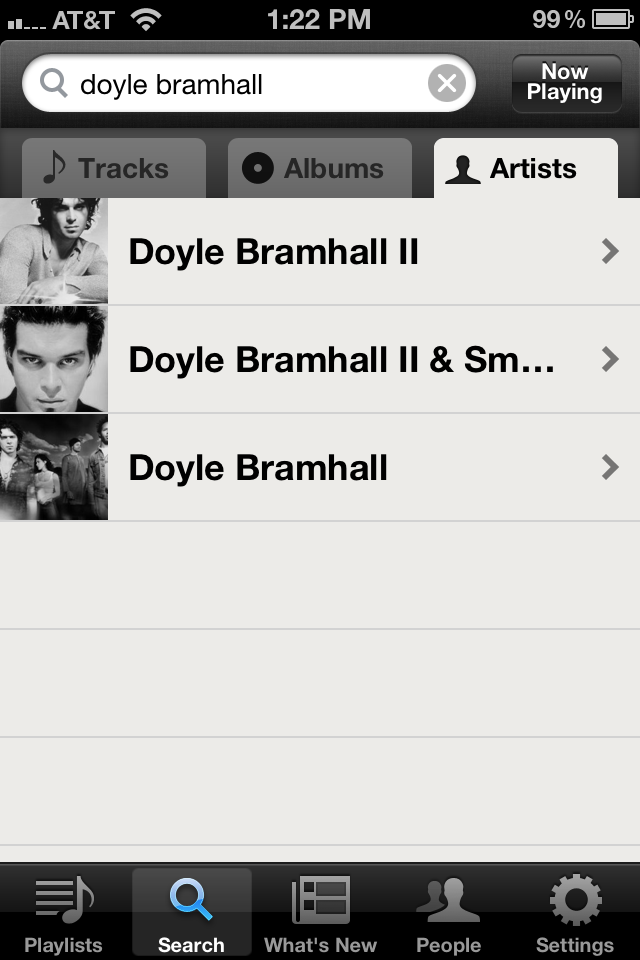
Hope you can spell, the search feature on the iPhone app version is not forgiving.
Lastly, Spotify is also a social network in that you can share your playlists and what you’re listening to with other people. I don’t like how the service REQUIRES you have a Facebook account, and it must be in good standing, you can’t sign up and then deactivate your Facebook account, if you do it shuts down your Spotify account. As someone who has a love/hate relationship with Facebook this is almost a deal breaker for me. If the service didn’t have so much music I’d probably back out of it. It’s also a bit creepy that everyone can see what you’re listening to on Facebook. Now you CAN enter a private session, where people can’t see that you’re listening to Brittany Spears…but it will eventually turn itself back on after a set amount of time. In my opinion, the feature should remain off until the user switches it back on.That said, it’s really cool to see what my Spotify-using friends are listening to. It’s awesome to send someone a track, artist, playlist, or album to listen to.
Overall, I love Spotify. I worry that since there was no contract I had to sign for my Premium membership that the rates will jump up with no warning. If the price stays the same and they don’t strip/limit the current features, then I’d heartily recommend it to anyone who loves music and wants to legally listen to music online. It’s strange to not own my music, but quite frankly my hundreds of CDs take up too much space. Now if I want to hear a song or album I don’t have on my computer, I can instantly hear it, without first hunting the CD down (again I have 500 or so CDs, so this is a real problem for me). I think most people should stick with the middle tier, $4.99 service because the app isn’t as good as it should be (for now at least, I keep praying for an update). That said, if you’re a music junkie like me, the Premium app is a good value ($120 a year for unlimited music? Hell yes!).
PROS: Massive selection of music, high-quality sound, affordable multi-tier membership plans, no more looking through your CDs, no contract to sign up, stream music anywhere even through a home sound system.
CONS: App could be better, App could kill your data plan if you let it, company is not upfront about the limitations of the free membership, no contract to sign up means prices could change anytime, no more looking through your CDs, you don’t own your music, you MUST have a Facebook account.
 Defending Axl Rose